
It never goes away. Discussions about point shooting - again?
Ford vs. Chevy, competing camera brands, other irrelevant controversies abound.
Now we’re back to point shooting. The degree of aiming fits along a continuum from no visual index to front sight focus (with irons) and people, as Ayoob points out, tend to talk past each other. There are those who have the one true method ™ that guarantees success - or it doesn’t.
I was asked by Clive Shepherd, when he heard I avoided point shooting and used the sights, “have you ever missed using your sights?”
Well yes - but that’s not a visual aspect problem, it’s a “convulsive clutch at the whole gun with everything from your index finger to your sphincter driving the muzzle away from the target” problem.
The visual could be one of the least important aspects of shooting - or not. It depends on where you are as a shooter, what it is you’re trying to shoot and what the context of the engagement is.
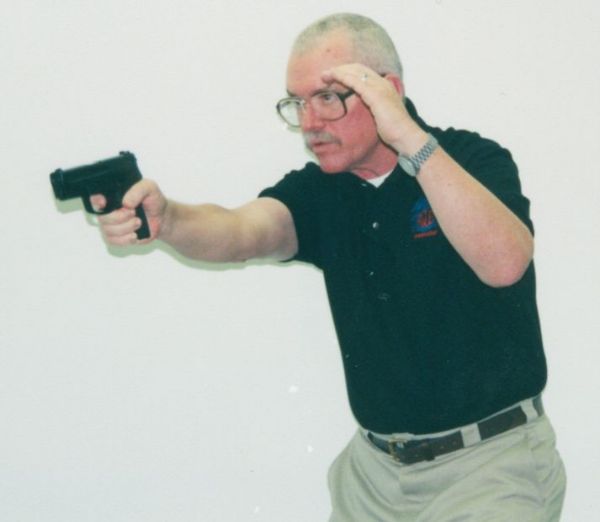
If the gun’s in the eye-target line, it’s aimed fire – even if you’re looking at the target, not the sights. If it’s body index, it’s still aimed - though so very coarse an index it’s easy to miss. If the target moves, you move, or if the target is at a different elevation from you, the body index becomes a big problem.
If the aimed fire is of a nature that requires precision, the appropriate iron-sights visual solution is focus on the front sight. It’s the last thing on the gun the eye sees before the projectile leaves the muzzle … or before the convulsive jerking with eyes slammed shut before you miss catastrophically.
If I’m trying to hit a 1.7” X-ring on a B-8 at 25 yards and the pistol has iron sights, looking at the target may not be the best choice. If I just want to stay in the 5.5” 9-ring, it may not matter.
It depends on the shooter.
It’s why I suggest an aiming continuum instead of a hard and fast rule; you need to see what you need to see to make the hit.
And you have to keep the damned gun still, which (it seems) is a far greater struggle.
We’re so visually oriented, we immediately go to the sights when there’s a problem hitting. A correspondent asked me about a disparity in points of impact when zeroing a night optic in good light conditions and when actually hunting at night.
There could be a range of reasons, in my view, including the simple difference in lighting conditions, “getting the buck” and moving the gun, not following through on the shot. The phrasing of the question though told me that the person with the question likely had the answer.
He figures the shooter is losing his cheek weld on the rifle, raising his head.
It’s often less the visual and more the body mechanics.
Settle down behind the rifle, work the trigger without moving the muzzle, follow through on the shot.
When I started this journey, the alchemy of “just point the gun” was alien to me. With the rare trainer, it was “use the sights.” You have to start somewhere and that’s where you start.
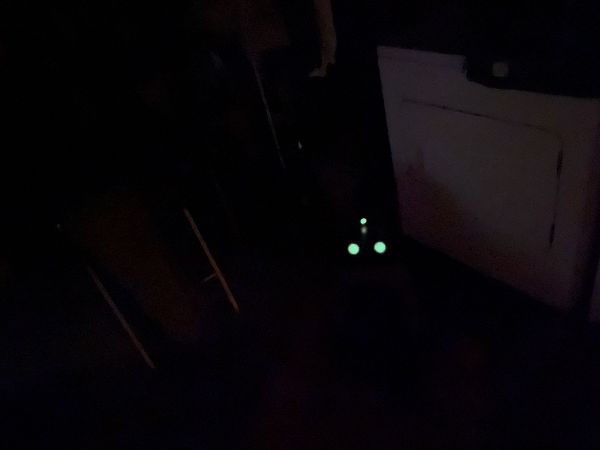
As you proceed and grow as a pistol shooter, you’ll find it’s less “see” and more “hold.” If you need coarse accuracy close, timeliness is of the essence. You’ll still tend to look at the target. As the shot becomes more distant, with the target appearing smaller, you’ll need to pay attention. With metallic sights, keeping them aligned in the eye-target line is king.
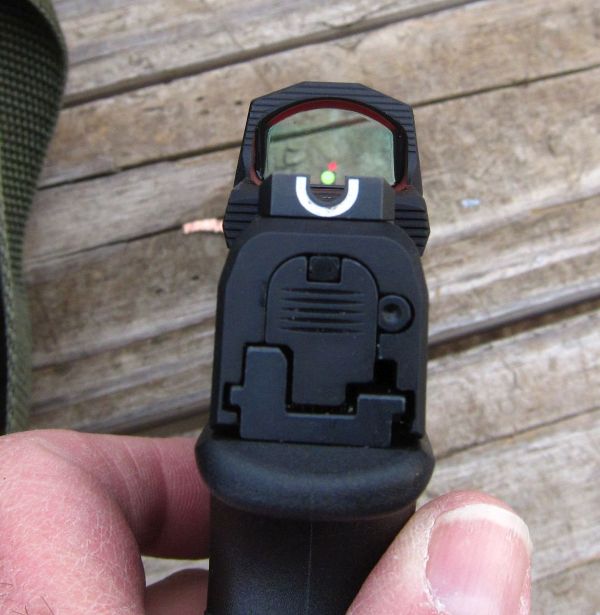
With the pistol-mounted optic, look at the target. The dot will float across part of that target. Hold tight and put constant pressure on the trigger.
– Rich Grassi