
This is Rangemaster’s “Drill of the Month” – a piece that has become a part of our feature rotation. It is part of that company’s monthly newsletter. As always, start slow before trying to progress. If you’re not familiar with use of the holster – especially from concealment – and, not familiar with the most dangerous thing you’ll do at the range, putting the gun into the holster – seek education first. You can shoot the whole thing from low ready, just to see how you do. Consider the aspect of moving with a gun in your hand. Your local range may have rules about that; needless to say, move with your finger OFF of the trigger and at high register on the gun, while keeping the muzzle directed into the backstop/target line. Don’t let the muzzle precede you as you move laterally across the range; the safe direction rule applies. Keep the muzzle directed into the backstop. And, as always, training is available: the instructors for Rangemaster travel. Check the website for information.

From the Rangemaster newsletter:
DRILL OF THE MONTH
Throughout 2026 we will be running a Drill of the Month in each edition of the newsletter. The goal is help motivate folks to get to the range and actually shoot their defensive weapons, and to have some fun in the process. Each month we’ll post a drill or a short course of fire. You are encouraged to go to the range, shoot the drill, and then post your thoughts and a photo of your target on the Rangemaster Facebook page, https://www.facebook.com/groups/rangemaster/.
- - And now to the drill of the month:
SCAT, the Short Combat Accuracy Test
Lots of shooters would like to know how their current skill level compares to an established standard. The best way to do this is with a hit factor (Comstock Count) scored test that covers a variety of useful skills.
The problem with a time limit course or drill is that it does not reward performance above the expected baseline. Let’s say two shooters have their own target at 6 yards, and the target has an 8” vital zone delineated in the chest. The shooters are told to draw and fire 3 rounds in 3 seconds. On signal, they do just that. Both have all 3 rounds in the circle, and both beat the 3 second time limit, so they both get exactly the same score. However, one of them did the task in 1.4 seconds, the other in 2.8 seconds. The second shooter took twice as long to perform the task, so he is nowhere near as skillful as the guy who did the task in half the time.
This drill is meant to be shot on a Rangemaster Q-5 or Q-6 silhouette, scoring the chest circle and head box as 5 points, the rest of the silhouette 3 points. If you must use an IDPA target, score the A and B zones as 5 points, the C zone as 3 points, no points for the D zone.
The score sheet follows, so you can print it and use it for your run. Total target points, divided by total time, X 20 gives you your final score. At the bottom of the page, you will see a score range with a skill level shown for each. These ratings are based on literally decades of watching police patrol officers, SWAT cops, military Spec Ops guys, and trained private citizens perform the listed tasks.
For the score ratings to be relevant, please:
Shoot this cold, no warm-up.
Street gear, fully concealed. No open carry or USPSA race rigs.
Shoot as fast as you feel you can get good hits.
Note: DHO-Dominant Hand Only/ NDHO-Non-dominant hand only
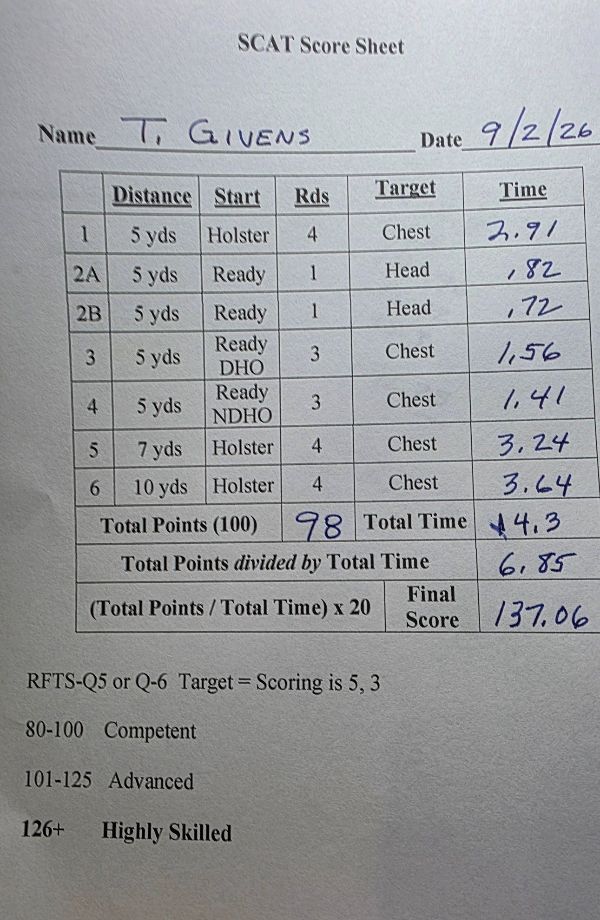
A blank score sheet appears in the newsletter (available here.) Print it and use it to record your run.
– Tom Givens, Chief Firearms Instructor, Rangemaster Firearms Training Services
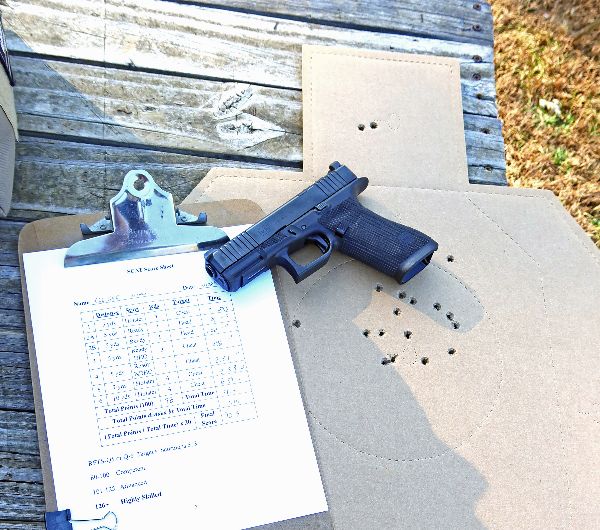
Editor’s note: I elected to try this drill of the month with the Gen6 GLOCK 45, a gun I’m still getting used to. I’ll limit excuses to the different feel of the piece (it took me 3,000 rounds to get me up to speed on the Gen3 GLOCK in 2001 – and I was younger then) as well as the relative height of the sights (optics-ready metallic). As a result, I was “looking for the sights” from the holster and from guard. Still, the accuracy was “okay,” and I’m judged “competent.” That will have to do for now. – Rich Grassi