
This story has nearly nothing to do with the classic Jordan River Holster and more to do with AI-generated nonsense.
When I first became aware of the proliferation of “artificial intelligence,” I was despondent about the lack of “human intelligence” (sic). Imagine my sadness to find that AI works from human prompts and humans are particularly good at being unable to recognize patterns.
And we’re “pattern recognition” beings …
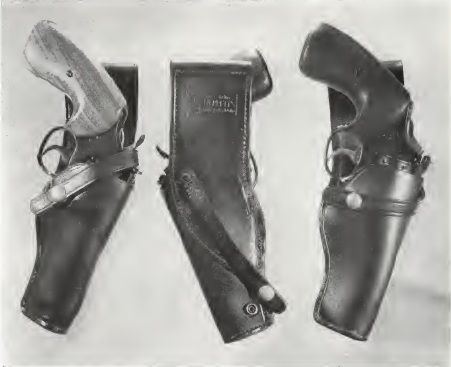
Bill Jordan took the old Border Patrol holster, slimmed it down and gave it a straight drop (originally – as he was a huge mammal and had a “long drop.”) It featured a steel shank in the drop loop giving it some rigidity and, with the garrison belt looped into the holster tunnel along with the Sam Brown belt, the holster was in the same place on your body all the time. For officers with a “short drop,” the holster pouch was tilted butt-forward to allow the toe of the holster to clear a car seat.
The design of the holster made it quick and “Long Will” (h/t, Chas. A. Skelton) was all about speed. If you need to retain the gun, snap the safety strap over it. He shouldn’t have to tell you to be careful.
The brainless machine intelligence (guided by humans, no doubt) said that it was the proximate cause of gun grab fatalities “back in the day.”
No, wrong again. To determine the likelihood of that, let’s analyze the gun grab. It’s a story not often explored these days – a very recent case in Kansas City KS confirms that point.
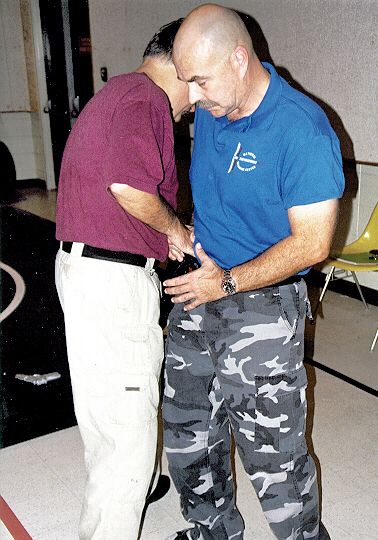
Back when I certified trainers in handgun/long gun retention and disarming (Lindell-KC system), Kansas City and Miami-Dade took turns for “agencies with the most gun grab” attempts annually. To sort that out, Jim Lindell created his system. We had a number-cruncher go over the available data. He found that around half of all gun grab attempts (on handguns) occurred when the officer had the gun in his hand.
So, there were attempts on drawn handguns and upon holstered handguns. One should also consider the condition of the officer when the attempt was made; there were cases around the country where the officer was disabled, then disarmed.
Blaming a holster for those attempts – on the drawn gun and on the disabled officer – is a problem of analysis, not of equipment.
There were holster frailties; some cases occurred where the gun was dragged out from the side, ripping the stitching of the holster. Needless to say, it’s not a “keep it simple, stupid” issue.
The problem ain’t simple and we ain’t stupid.
Years ago, Massad Ayoob proposed a layered defense of the firearms you carry. I adopted it in my teaching because it made sense. The first layer is awareness.
This won’t surprise you, but the biggest threat to law enforcement – well, to anyone – is just not knowing that the fight has arrived at your door. You have to be actively looking for a problem and either avoid the near occasion of the problem or devise a plan to overcome the offender’s resistance. Which of those you do depends on the mission. If you’re old and retired, you must attempt to avoid-evade-escape.
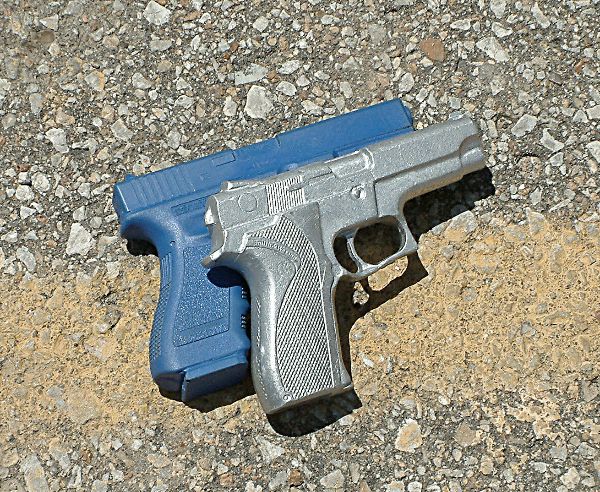
If you’re on the job … you caught ‘em, you clean ‘em.
Gun retention training is critical. There are vendors who take care of that, but I root for the home team.
It’s no surprise that people tried to buy their way out of the gun grab threat; enter the security holster. The first one I noted was the (at the time) latest rendition of the Berns-Martin. An open-front holster, many from Bianchi like the Model 27 and Model 2800, they prevented successful grabs from behind. The Hoyt holster was similar, a great rig – easy to draw from, but not quite as secure.
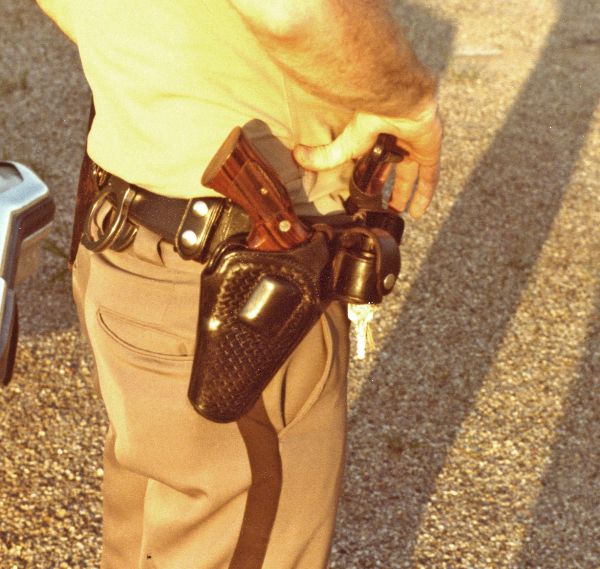
This was followed by holsters that feature the Rogers-developed “Level” system of described retention features. A holster that was considered Level 3 by the designer (Bill Rogers) was the Safariland SS-III 070, a rig that was optional for officer-purchase, then later issued at my agency. For information about the history of security holsters, see this article.
Concealable body armor was a life-saver for officers in the gun retention context as well; if you didn’t wear it, it didn’t matter. If you wore it, it was one more potentially life-saving layer.
Finally, a handgun with a user proprietary operating system could help – and did in a few cases. It was a matter of carrying a handgun with a manual safety (horrors!) that could confound the attacker for the moments it took to use physical control tactics or to draw another gun –
The other gun was another layer in the gun grab defense plan.
To credit the Jordan holster with officers killed or assaulted with their own guns is simply AI-BS. It wasn’t nearly the whole problem, any more than any of the other holsters available in the era.
Gun retention is still a significant issue. Knowing when a problem is a hands-on problem or a remote-control problem (h/t, V.O.) is a big part of the analysis.
– Rich Grassi