
“It is foolish and wrong to mourn the men who died. Rather we should thank God that such men lived.” -- George S. Patton
Vincent P. O’Neill was a grand man, a great character, as close to a Renaissance Man as any I’ve known. I really should have crossed his path before I did; we worked in operational areas less than 30 miles apart. My friend and partner had an interesting experience during a chase my partner kicked up that went into the adjacent county. Vince attempted to stop the lawbreaker; Vince and my partner met years later, and found that they accompanied that same close encounter.
Vince was described as a “cop’s cop,” a brother, someone who looked after those less abled. That was a small percentage of his “knowledges, skills and abilities.”
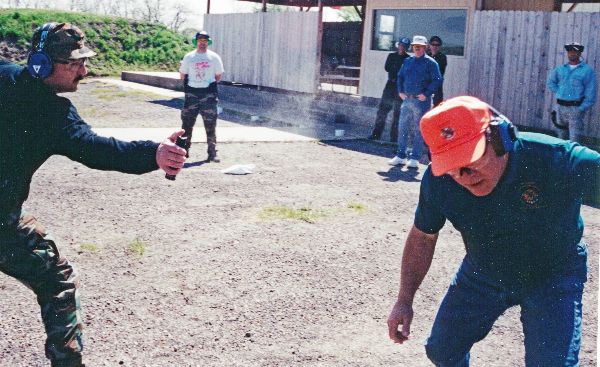
A speaker of three languages, a depth of knowledge of psychological and physiological aspects of sports training and deadly combat, a master with firearms, nightsticks of various types, “aerosol subject restraints,” other tools of arrest and of the sketch artist’s pencil.
That last understates his ability to draw a “cut-out” view of human anatomy, showing with precision the muscles, veins, arteries relative to what we see when we look at other humans. Before there was AI there was “VI,” an encyclopedic depth of knowledge.
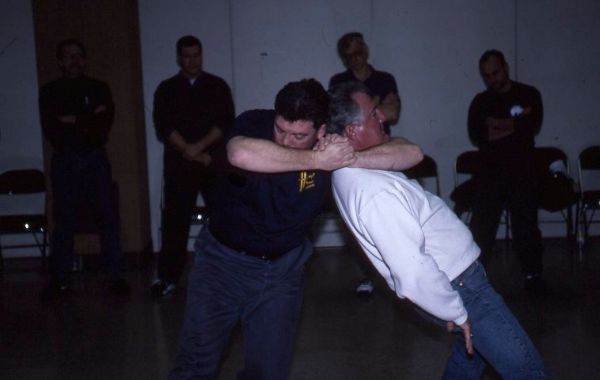
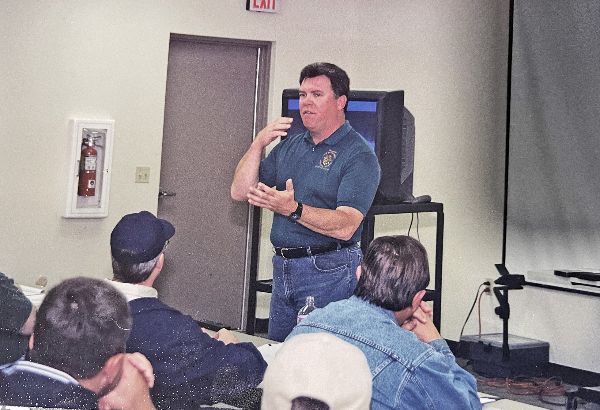
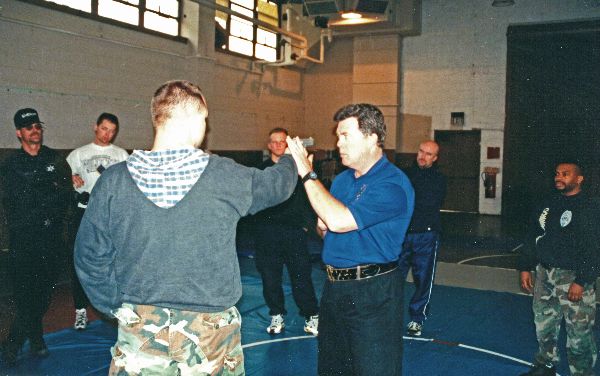
He imparted this knowledge through lecture, discussion, demonstrations of skills and chats during breaks and after hours. A cop’s cop, he was also the instructor’s instructor – mentor, confessor, therapist.
Articulate in verbal and written communication, you knew he was getting wound up when the words he used got longer and longer.
There were times that Chuck Haggard and I would look at each other, amused that students in the crowd took on the attitude of the RCA-Victor dog, head-tilt, and hearing “His Master’s Voice.” Later, in the mat room or on the range, head-tilts turned into the “light just came on” epiphany.
He taught much through the example he set. While Vince was a cop and had played football for the Buffalo Bills, he was soft spoken – the truly strong seldom raises his voice – and not routinely vulgar.
He would speak with students long after class, as long as they wanted. And they couldn’t leave; he was magnetic.
Vince wasn’t in love with the sound of his own voice. He had a message and that message was to keep in the fight. It may not go your way; you may be injured horribly – but that doesn’t excuse you from the engagement. Carry on.
It’s your duty.
People remember him quoting from Theodore Roosevelt’s speech “Citizenship in a Republic,” delivered at the Sorbonne in Paris on April 23, 1910.
“It is not the critic who counts; not the man who points out how the strong man stumbles, or where the doer of deeds could have done them better. The credit belongs to the man who is actually in the arena, whose face is marred by dust and sweat and blood; who strives valiantly; who errs, who comes short again and again, because there is no effort without error and shortcoming; but who does actually strive to do the deeds; who knows the great enthusiasms, the great devotions; who spends himself in a worthy cause; who at the best knows in the end the triumph of high achievement, and who at the worst, if he fails, at least fails while daring greatly, so that his place shall never be with those cold and timid souls who neither know victory nor defeat.”
Vince was the man in the arena.
Massad Ayoob has referred to people like Vince as “teachers of staying alive.” I’m not sure that Vince saved more people than concealable body armor, but I’m not betting against him.
So, this is less an obituary than an expression of profound gratitude. I thank the Almighty for giving us Vince O’Neill.
His memory is a blessing.
– Rich Grassi