
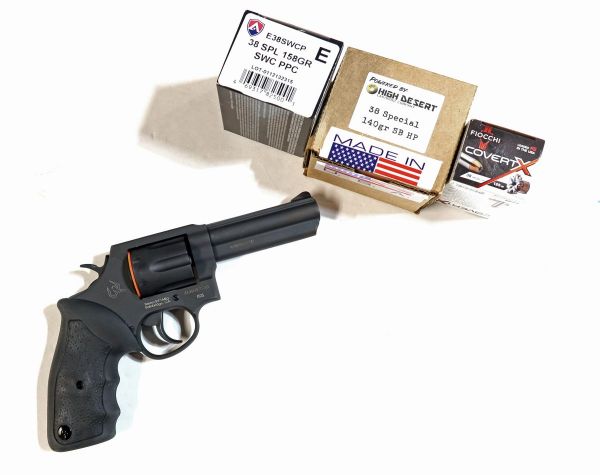
Like many, I’ve seen and read about Caleb Giddings’ extensive use of the most basic Taurus revolver. Described as a “security guard’s gun,” apparently a number of agencies, private and public, in South America make extensive use of the Model 82.
A fixed sight, four-inch 38 Special revolver, rated for +P ammunition, it’s analogous to the guns worn by US police and security since before WWII.
When last I took note of Caleb’s trek with the plain old 38, his gun had consumed around 13,000 rounds of ammunition. He shot it at matches where “modern” semi-autos and pistol-mounted optics covered the ground. He shot it at distance, with an enviable group, and shot it quickly in match prep and competition.
And he’s carried it concealed more than just a little.
That’s confidence.
Before you say he’s “bought off” -- as an associate of Taurus -- he knows full well that people on the outside will follow up.
As I am, now.
The nicely balanced stock revolver has a barrel profile to fit L- and GP100 holsters while sporting a cylinder that accepts the HKS 10A speedloader; in short, K-frame dimensions and geometry.
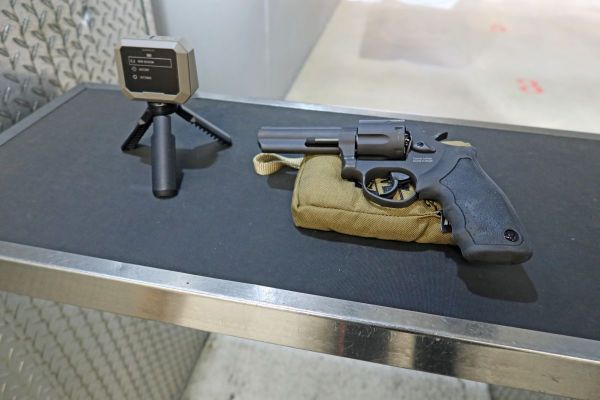
The only lock to give the “we don’t need no safeties” crowd fits is in the base of the hammer, below the spur. As it’s not a safety, we needn’t be concerned.
The stocks are rubber, with a nice grip angle and a pronounced recoil hump. That makes it easy to get a high grip on the gun in the holster. There’s a pebble-grain texture and the stocks cover the backstrap. That could be a problem for those who can’t reach the trigger, but these aren’t extreme. The upside is cushioning the recoil, making the shooting process pleasurable.
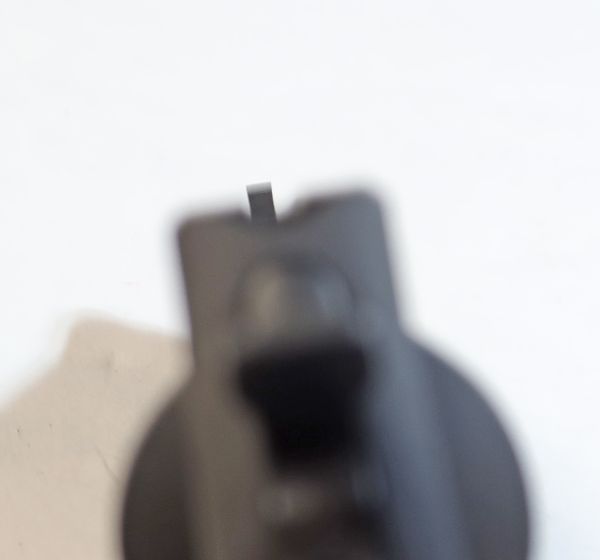
The sights are the sadly-industry-standard short to the bore line sights; and there’s not enough space in the rear notch on either side of the front sight. That’s not enough to close the door; we deal with that on other guns.
Caleb has noted that the gun is regulated for 158 grain-class projectiles, more-or-less, as opposed to the move by some makers to regulate their sights for light-for-caliber loads.
We’ll see.
The face of the trigger is smooth and it’s wide enough. The hammer spur, service-style, is wider than the hammer but not a big flap of steel.
The firing pin is frame-mounted and a transfer bar (actuated by the trigger) has to move into line with the firing pin. The hammer hits the transfer bar, transferring energy through the transfer bar to the firing pin.
Take the transfer bar out or shorten it and the gun doesn’t fire. It’s about as safe a system as there is.
The four-inch barrel is full-diameter from the frame to the muzzle with an underlug for additional weight. I’m not sure it’s necessary, makes a ca. 35-ounce revolver weigh 37 ounces, but it doesn’t hurt anything.
The ejector rod is protected by the shroud provided by the underlug and it’s long enough to clear empties from the cylinder.
Single action is, well, firm. I can’t say “stout,” but it’s getting there. Double action is smooth and it’s not as heavy as I remember some service revolvers of the past.
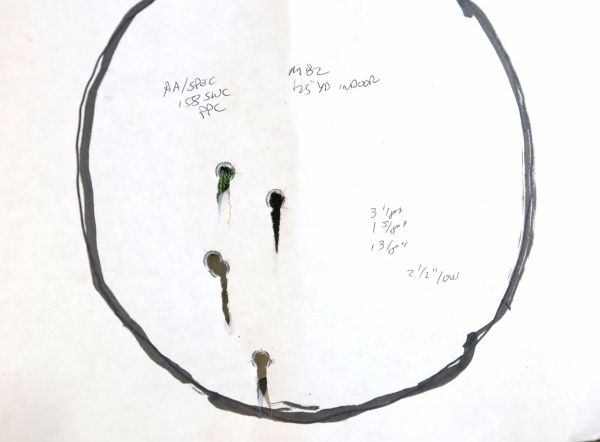
I tried five different loads on an initial trip at an indoor range. The target, set at 25 yards, featured the outline of a B-8 repair center (blank target drill) and four 8-inch circles. I intended to get, as best I could, an idea of each load’s velocity from the 4-inch Taurus, a five-shot group while attempting to determine where the gun hit, relative to the sight picture, at 25 yards.
The High Desert 140gr. XTP “Short Barrel” load (forgive me, it’s what I had), hit three inches below point of aim and averaged 892 fps. In the lighting of the indoor range, with the relatively small sights, five shots measured five inches. That includes a flier, without which the group measured 2 1/8” (more like it), with three hits in 1 5/8”. The average velocity was 892 fps.
Fiocchi CovertX 125gr. JHP +P hit seven inches low. Five rounds went into 3”, with four into 2 ½”. The best three hits clustered into .5” … Velocity was 1,037 fps.
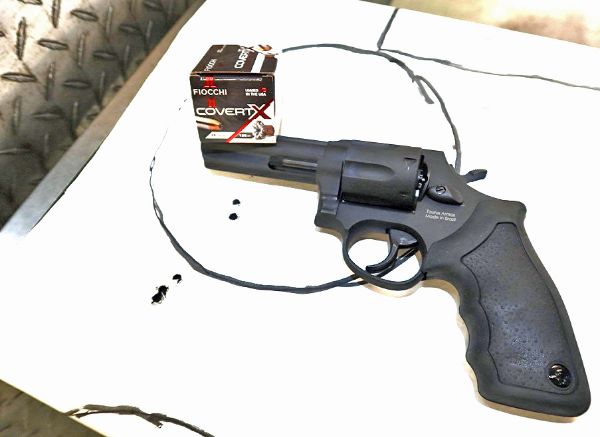
DoubleTap 125 grain FMJ-Flat Point averaged 995 fps, hit 6” low and put five hits into 3 1/8”. Federal Tactical 129 grain HydraShok HP yielded around 990 fps, hit 4” low and put all hits into four-inches. Without (my) flier, the group measured 2 7/8”.
Finally, the Atlanta Arms Elite 158 grain SWC – PPC match averaged 706 fps, hit 2 ½” low (could be the lighting in the range) and put five rounds into 3 1/8”. The best three were in 1 3/8”.
That’s a good start to see what this basic gun can do.
Home defense? Sure. Concealed carry? With the right holster, yes.
– Rich Grassi