
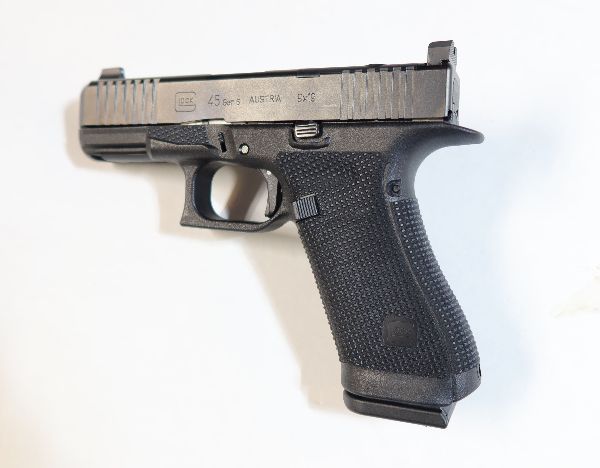
Often, when a new pistol from GLOCK arrives, it has the plastic “place-holder” sights. Knowing that people will select their own favorites – or, in the case of the optics-minded, have a specific height requirement for back-up iron sights – why put expensive sights on the guns?
The latest in the stable, a GLOCK 45 “crossover” (G17-ish frame with G19-ish slide) is a Gen6 with the new optics mounting solution. Still, a set of sights from XS, their Minimalist OR Optic Height Sights for Glock MOS, will fit.
That’s what I used. As the gun has an optics cut with a cover plate, a rear sight that extended in front of the dovetail would preclude the mounting of glass – which is why the gun is here. XS has their “Minimalist OR” (optics ready?) extending to the rear of the slide, for very slightly longer effective sight radius.
I’m not sure it’s enough to matter.
The sights have a Black Nitride finish for corrosion resistance. I opted for the front sight with tritium – as the gun will mostly lack the assistance of optics unless needed for testing. The rear is blacked out and serrated. The sights are set to enable a low co-witness with RMR/ACRO class optics.
The kit included front- and rear sights, and a tube of thread-locker material.
The XS “Gunsmith” In-Line Sight Pusher made removing the rear sight trouble-free. Installing the new rear sight took some file and fit, but it’s a good, tight fit. Using the ‘handle’ from the sight pusher, itself a nut-driver to install the front sight, it was short work to get the sights on and let the thread locker cure.
Regardless whether the sights being replaced are mechanical or electro-optic, checking zero is obligatory. I figured that the sights would be set for a 6 o’clock hold. In this case, it was a correct assumption.
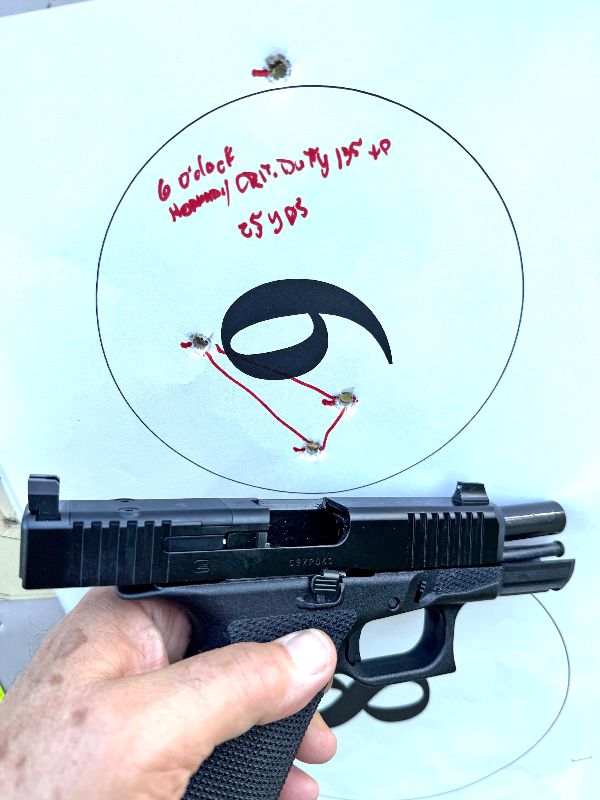
I started the shooting test with Hornady Critical Duty 135gr. FTX +P, as that’s the ammo most likely to be in the gun if it’s needed for concealed carry.
Shooting two-handed at 25 yards and holding on the base of a six-inch circle, the point of impact was two-inches high, with three of the four hits going into 2 ½”. The single high flier was called – my fault.
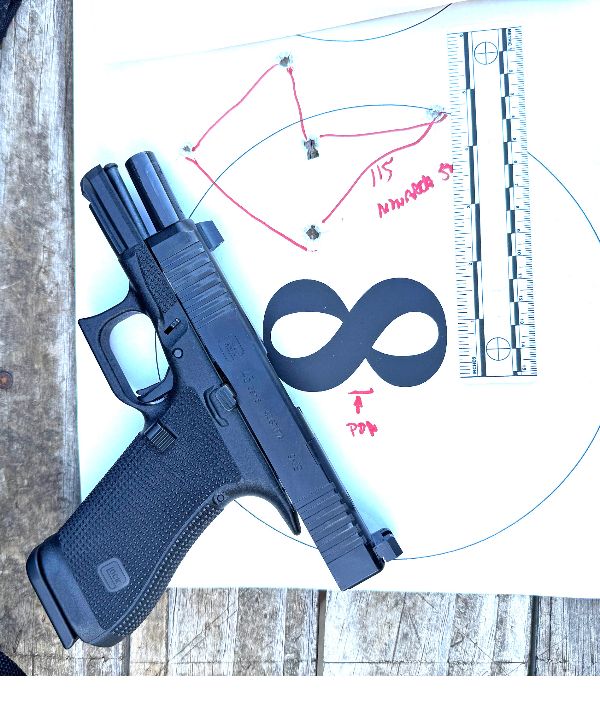
Shooting from 25 yards, one-handed, with range ammo, I hit nearly 4 ½” over the point of aim. Again, three hits of the five-shot group, clustered into 2 ½”.
With the same low-cost range ammo, I shot from fifty yards. The group centered nearly 11” over the sights. This was fired on a reduced size NRA TQ-19 analog, a Birchwood-Casey “Shadow Target,” 12” x 18”. (The reduced size TQ-19 is the TQ-20 and this is close in size to the smaller target.)
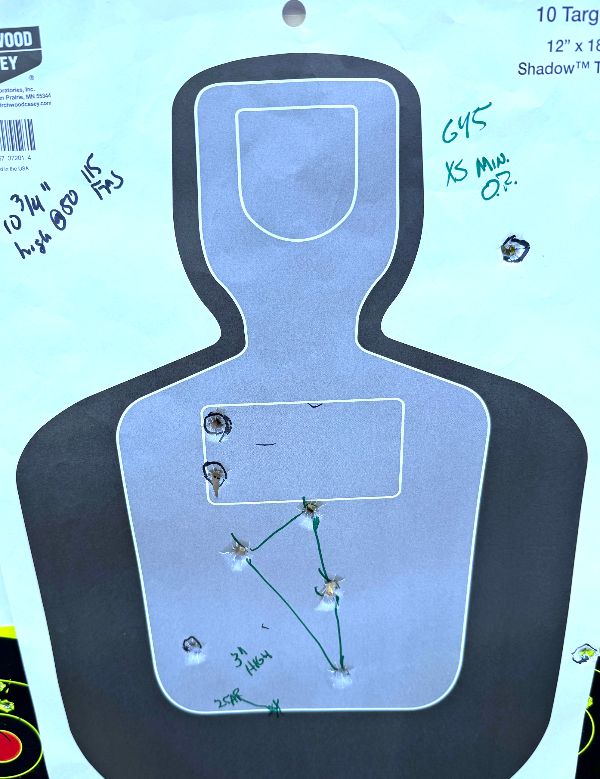
There were two off the silhouette, both on paper. Another pair struck the center box and there was the last round in the shaded scoring area, low left.
I was holding at the base of the silhouette – not the shaded area of the target.
Moving up to 25 yards and having learned from fifty, I held on the based of the gray shaded scoring area. I hit three inches over the sights with a five-shot vertical group.
Three of those rounds were in two inches, with the whole group at 4” high and 1 ¾” wide.
The gun is fine, the shooter not-so-much.
A few days later, the newly-sighted G45 was back out on the range with another of the Birchwood-Casey “Shadow Targets.” This time I was moving into “more practical” work.
I contrived a 25-round handling course to be shot on the reduced TQ-15 analog, just to see how I interacted with the sights. I noted I was a bit slow – every string was timed – and there was a mix of holster work and shots from an unholstered ready position.
I started at 25 yards, for accountability, with five rounds. These were delivered in timed strings of a pair from the holster, from ready to a pair, and a single from ready. I had a hit outside of the gray-shaded scoring area, still on the silhouette – in the “neck” on the left. The remainder were inside.
Moving up to three yards, I went from the holster to a single hit and from a holstered ready position (hand on holstered gun in a firing grip), both to the head. I finished with hits from a compressed ready.
From seven yards, it was a pair from the holster, followed by a ‘failure to stop’ drill. Ten yards saw a couple of pairs from the holster followed by a single from guard.
Finally, at fifteen yards, I shot a pair from the holster, a pair from guard and a single from guard.
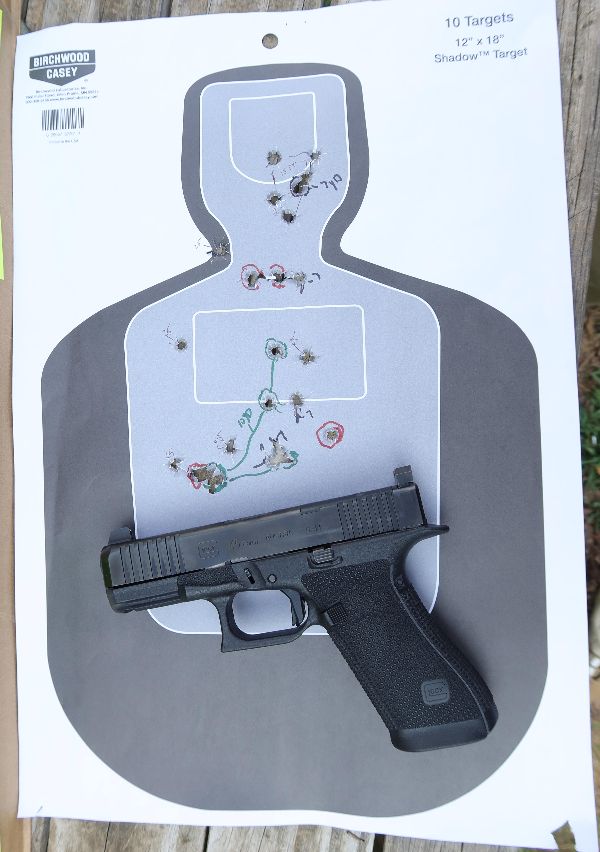
All the rounds were accounted for, none off the silhouette and only one in the -1 (as a TQ-19 would be scored.
So, what about the new sights? They’ll do. I did a lot of shooting with the factory-supplied plastic sights and they served the purpose of steering the bullets too. I just have to remember the hold on this gun when using the M-OR sights.
A return trip to the range so I could confirm the “hold under” with the XS Sights had me shooting one-handed at fifty yards on the B-6 target. The first string, I held with “white” showing between the top of the front sight and the bottom of the bull – about a low “6.”
Three of five hits went low (30/50, if it matters). For the next string, I held six o’clock on the bull. Only one hit was low, a “9” at 5:30. The score was 38/50.
Hold does make a difference.
To check the shooter, I used the G44 with Remington Golden Bullet ammo on the same target. I was more scattered, particularly on the 2nd string. I found that I was still having low rounds, but that was hold – not the sights, the gun or the ammo.
Closing to 25 yards on a B-8 center, I shot the G45. My hold was a little high, the bottom of the bull, and the five hits clustered just over the bull into two-inches.
All that just to make sure I knew where the rounds would go when the gun was fired. Making sure of your hold makes all the difference.
– Rich Grassi