
Using shorthand statements as reminders of concepts taught through discussion-lecture, demonstrations and application, is so common your parents used it when you were small.
“No hitting! Violence isn’t the answer.”
A general statement of truth – look at the history of conflict in the Middle East, the Hatfields and McCoys and people who still want to debate the American Civil War – violence is seldom the solution to problems long term. Everyone gets a chance to lose – and get a chance to win – as long as the battle continues. The only way violence solves is when it’s soon enough, strong enough and decisive enough to make the other side just want to forget the whole thing.
Or when you’re looking at extinction and your only chance is to destroy the opposition – right now.
But we also go back to the training mantras, so many that are mindlessly repeated – on the range, in the gun shop, on the internet.
There’s a context for each and they all mean something. Ignoring the context and dismissing it as “Fudd lore” isn’t a solution. Soon you’ll find yourself using shorthand, a pneumonic device, to remind yourself and others of vital lessons.
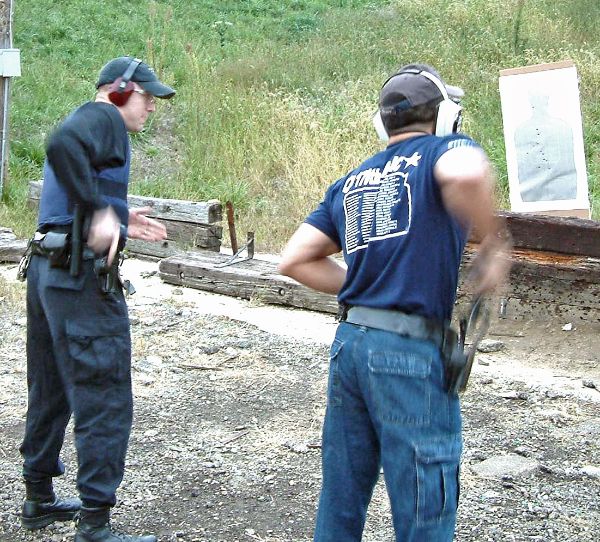
Slow is smooth, smooth is fast: Well, no. Slow can enhance smoothness and efficient action, leading to long term greasing of the neural skids between brain and limbs. Doing so, by the numbers, repeatedly, regularly, over time can lead to seemingly effortless and very quick performances.
Taken within the context in which it was explained, the old “smooth is fast” takes on serious meaning.
But not for people sitting on their asses gazing into video screens – it’s reserved for those who make the effort.
When you step around the corner and look into a muzzle, the time for discussion and deescalation is well past. Decisive, bold action, a violent attack, is what’s left. In a very narrow range of likelihoods, violence is the only answer.
Better you take that corner wide, look before you leap.
Similarly, material misstatements of fact, chanted over and over, become internet-common, like the stupidly repeated “21-foot rule,” something that’s not a rule and has little to do with 21 feet.
Add to that, the line officer trying to coach a shooter by murmuring “front sight; front sight” into the ear pro as the shooter spasmodically clutches at the gun with each round fired.
We had a discussion about the use of pistol-mounted optics at the last event at the local Sheriff’s range. The agency has optics on service pistols and has “non-lethal marking cartridge” pistols with optics mounted. Some of their people attended a school with a force-on-force component.
The other participants had marking-guns without optics. According to the local attendee, “We smoked them!” His take was that not having to focus on a front sight – looking through the optic at the unfolding threat environment – increased situational awareness and enhanced effectiveness in proper threat management.
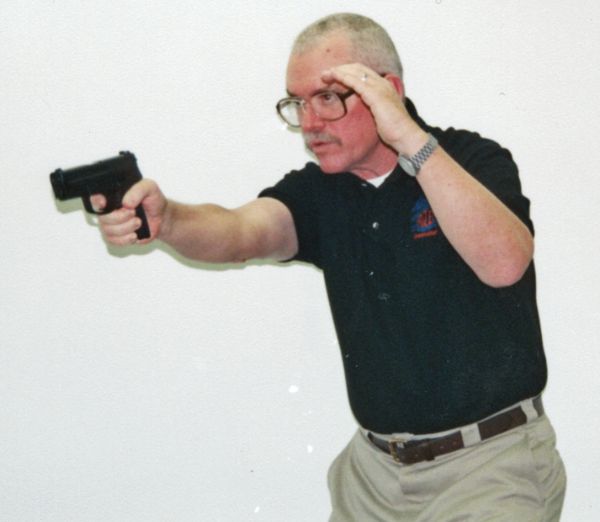
Sounds a lot like Fairbairn from his Shanghai Municipal Police and WWII experience. Those handguns didn’t have optics either. They had tiny sights all but unusable in the dimly lit environs of engagements back in the day. They focused on the target – the deadly threat – and pointed the gun at it.
But you have to see your sights to shoot effectively? Well, sights are good – but after a certain point in your shooting career, they serve to confirm what your hold tells you.
Walt Rauch called them “training wheels.” Jeff Cooper, in his book To Ride, Shoot Straight, and Speak the Truth said, “A correct firing stroke — from leather to lineup — aligns the pistol reflexively, once it is neurologically programmed. The sights are not used to align the weapon; rather they are used to verify an alignment already achieved by means of a trained presentation.”
Training wheels indeed.
Most misses are created by moving the gun during/before ignition – unless there’s a legitimate vision issue, and that happens.
Nuance, shades of gray, non-binary – that’s life.
The right thing at the right time.
- Rich Grassi