
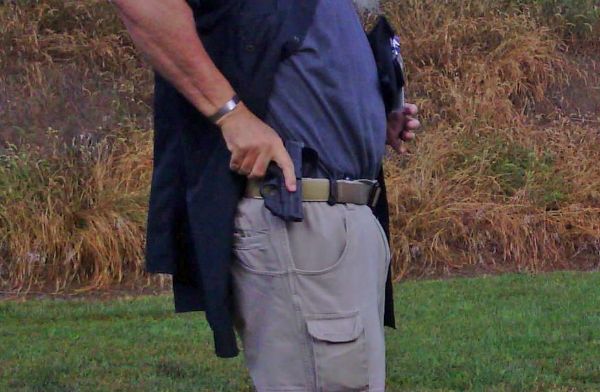
From Stephen Wenger’s Defensive Use of Firearms digest (available here at no charge) –
"Rules Violation: A now-former Georgia police officer has been charged with involuntary manslaughter after he accidentally discharged his weapon during an arrest, fatally shooting a teenager he was attempting to handcuff, according to court filings …"
Stephen notes that this appears to be a case of an involuntary, sympathetic contraction of the gun hand, perhaps when the offender moved or while trying to apply the restraints. He also asked, “… if Harris was uncomfortable holstering his pistol to cuff a seemly compliant, proned-out suspect, why didn't he await backup?”
In response to a social media post on an earlier piece on the skill of reholstering one-handed by feel, an internet-type wrote: “If there are still potential threats you do not reholster.”
Oh, my ...
When aren’t there “potential threats?” When the director yells “cut!”?
The last thing you want to do is stow the gun that just saved your life. But when you’re not in a controlled environment, you’ll have to - and do it safely - potentially “without looking” because there are other issues demanding your attention. For one thing, the lighting may not allow “looking it back into the holster.” For another, there may be other threats ("seeded" backup) or responding law enforcement or armed citizens.
Care to guess what they do after shots fired - and they see someone with a gun in their hands?
Some skills are essential and have to be drilled. Watching it back is a critical part of learning. It’s not the end of the game.
From Dave Spaulding, we have this: “While some dispute this, I think you need to recover to the holster without looking! We are all products of our own experiences and my LE experience was...time and time again...that I was involved in another activity while I holstered whether it was fighting or rendering aid.”
To hear Army SF SNCO Pat McNamara tell it, “… in the tactical world, we must sometimes have to deescalate and go ‘Hands On’. We must do this without taking our eyes off of the threat.”
That’s hardly an administrative task.
We remember the member of the Secret Service at Butler PA caught on video, trying to find the holster while working exec protect – and finally just keeping the gun in hand until a look into the holster was possible.
That’s a no-go at this station.
Another social media type noted, “I’m still not convinced that taking your eyes off of your surroundings after just having to defend your life is the best idea.”
So, you’re in a fight for your life. Ears ringing, people around the area, subject down (temporarily, perhaps; reanimation is a thing) – did someone call the constabulary? Is there someone else in the accumulating crowd who’s armed?
How do they know you’re not an “active shooter” (sic) or the bad actor in this play?
How would responding police know?
As Ayoob has noted, time and again, being able to holster, one-handed, by feel is a real survival skill to develop. One doesn’t rush development. It’s crawl-walk (I won’t be running to this part). A dummy gun, or a gun deactivated by a chamber/barrel block, can be used in dry practice.
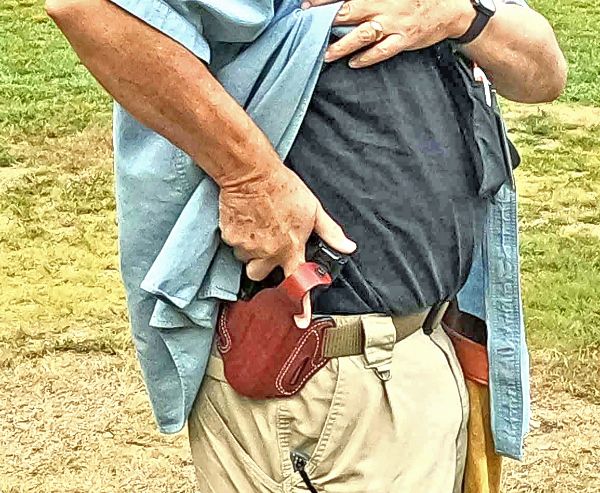
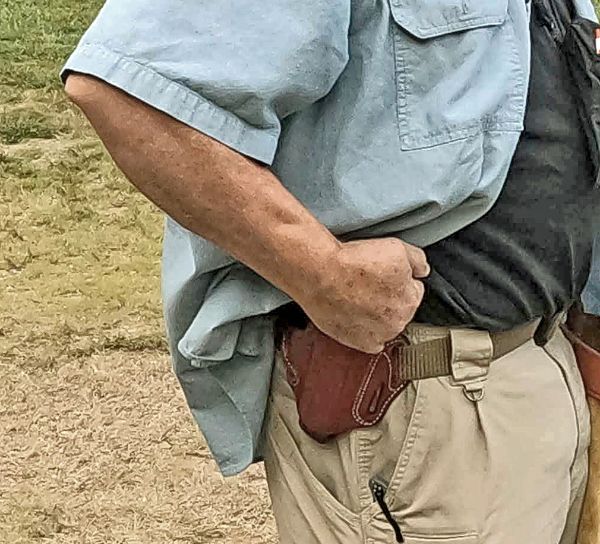
What about concealment garments? Well, a Pat Mac thing is “reverse the draw.” So, clear the garment, then I add a sweep of the holster mouth with a flagged thumb, holster from the back, using the dust cover of the auto to guide the gun into the holster.
Safety straps complicate the matter a little. Taking the gun back to the holster – without using the other hand – use the index finger to come in behind the strap, push and hold it out of the way, while you feed the gun into the rig from the back. Once the gun is seated, the trigger hand wraps around the holster, holding the ends of the strap together and snapping it shut.
It just takes a little practice and we can all use that.
– Rich Grassi