
If you want to be able to shoot at all well at 25 yards, you train at fifty yards. That’s the take from a bullseye shooter – at least one and likely many more. It’s also the take of Pat McNamara, a name familiar to those interested in the tactical/personal protection aspect of firearms.
They’re right. It’s a lesson I was forced into in 1986 that’s come back to haunt me.
Back in the olden days, I found I’d developed a trophy-class “flinch” habit. Poorly described by many, including me, over decades (perhaps, over a century), this “pre-ignition push” causes one to nose-dive the muzzle just before ignition. If you “call the shot,” you likely called it “good enough.”
It wasn’t. For a right-hander, that round sank low left.
Out of every course of fire I shot for the outfit, one – and one only – sank low out of the scoring area. Ball and dummy exercises helped only momentarily. On one fine day, a reserve officer – and gun guy from before I was born, who’d forgotten at the end of his life more than I’ll ever know – took me aside and said, “I think I can help with that.”
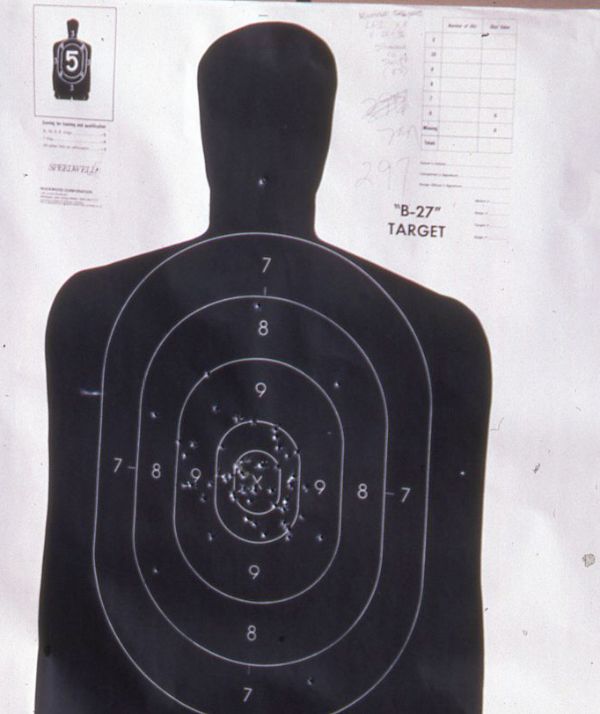
The solution? He loaned me an extra magazine for the company-issued S&W 645, so I’d have four of them, and he schooled me on NRA Police Combat Match #5, stage 3. This was from 50 yards, 24 rounds in 2 minutes, 45 seconds, from four positions, with three reloads. From standing, you move to sitting for 6 shots, reload, go prone for 6 shots and reload, to standing left-side barricade, shooting with the left hand for 6 shots, finishing with six rounds from the right side of the barricade, using the right hand.
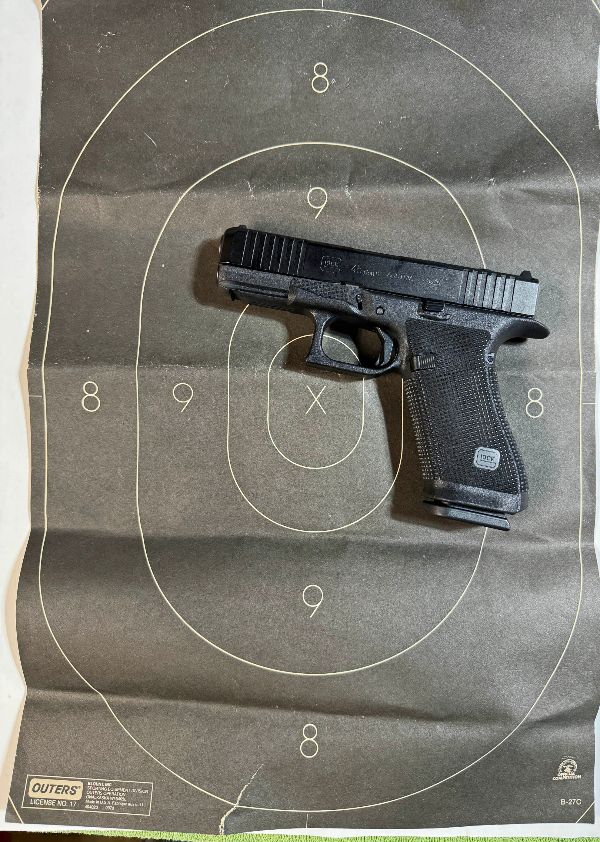
This was fired on the NRA B-27 target, a huge silhouette with ISU scoring rings.
There’s an “X” in the middle. Using a B-27 repair center from Outers, I measured it at 2 1/8” wide by 3 1/16” high. The “10,” if that’s what you’re shooting for from fifty yards, is 4” wide by a generous 6” high. The 9-ring is about 9” by 12”.
The “8” ring is considered worth 5 points for scoring in training and qualification mode. That is a foot wide by just under 18” high. Shooting for that “perfect” score qual style just required staying in that 8-ring.
I don’t have the words to discuss how difficult that was; first, I had to hit the barn-door sized silhouette at that distance – from four positions, with a draw and three reloads, as well as shooting with either hand.
If it were easy, everyone would do it. Harry was patient. He’d make the trek to the target to read it and repair it. He’d coach me on position shooting – taking one’s mind off of “the sights look good right … NOW!” and jerking the muzzle down two feet.
With the 45 and the loads we used on the range, I used a “neck hold,” using the head of the silhouette balanced atop the red ramp of the 645 to drop those lead slugs into the middle of the target.
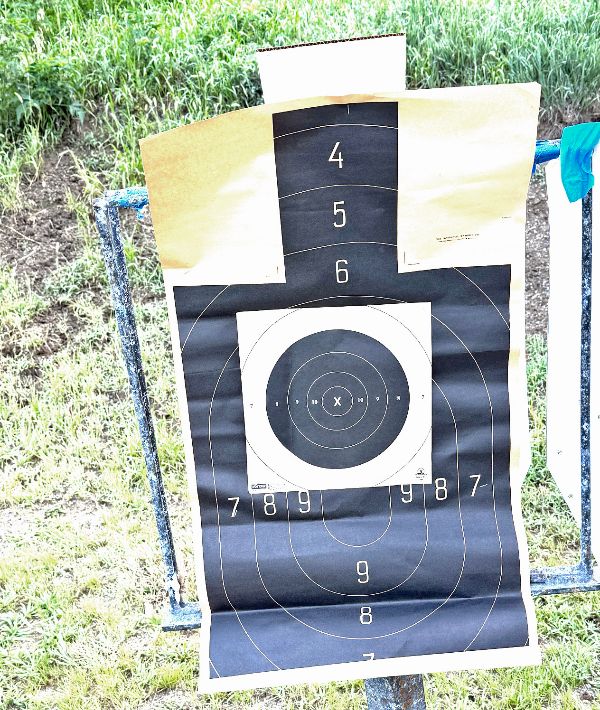
Now, in my dotage, I find myself having trouble when I try to “hold hard, shoot straight.” So, it’s back to the fifty-yard line. I’m not getting down into sitting and prone, then trying to stand. This time, it’s bullseye.
I had no B-6 targets or repair centers on my first try. I made do by covering a shot-up cardboard backer with the upper part of an old ISU silhouette and tacking a B-8 repair center to it.
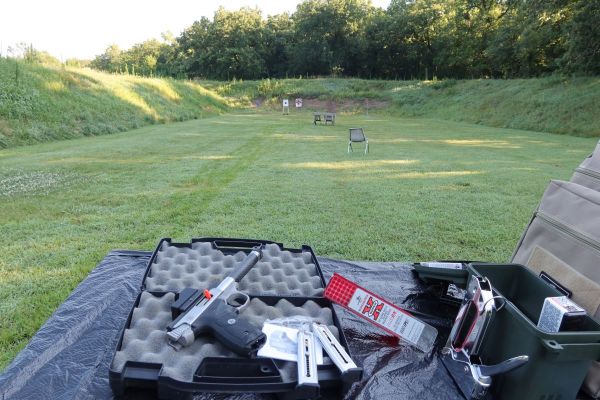
If it’s bullseye, we shoot it “one-handed, the way the Good Lord meant for us to.” I started with an early Smith & Wesson SW22 Victory, this one with a Volquartsen barrel and an elderly C-More RTS2 optic. Winchester Super-X 40 grain high velocity isn’t match ammo, but I’m not a match shooter.
The first string saw a hit low, where the “6” would be. There was an “X,” a “9,” a pair high above the repair center. The second string featured three in the 8-ring, a nine and a 10. Scoring as marked, I had 43/50. Before I pat myself on the back, counting it -1 per each scoring ring gave me 38/50.
I’d still take it.
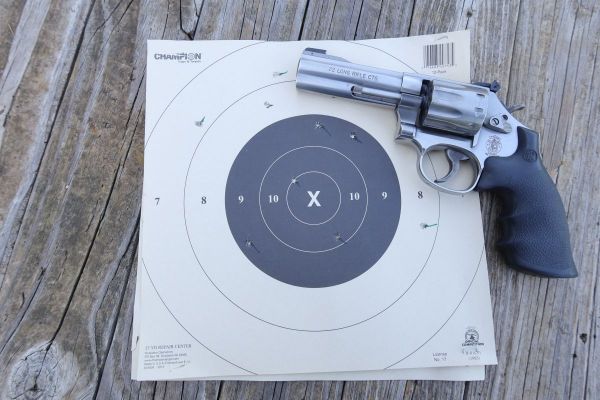
Trying with the S&W M617 4-inch 22, using CCI Standard Velocity and iron sights, I didn’t fare so well, with few hits on the repair center. I followed up with a pair of timed fire strings at 25 yards, posting a 77/100. Not great, but I shot vastly better at 25.
I’m continuing down this road, shooting 22 autos with and without optics, just to see what’s happening, as well as shooting “service pistol,” to see if the long line has any relevance to regular defense marksmanship.
– Rich Grassi