
This is Rangemaster’s “Drill of the Month” – a piece that has become a part of our feature rotation. It is part of that company’s monthly newsletter. As always, start slow before trying to progress. If you’re not familiar with use of the holster – especially from concealment – and, not familiar with the most dangerous thing you’ll do at the range, putting the gun into the holster – seek education first. You can shoot the whole thing from low ready, just to see how you do. The Rangemaster instructors travel. Check the website.
From the Rangemaster newsletter:
DRILL OF THE MONTH
Throughout 2026 we will be running a Drill of the Month in each edition of the newsletter. The goal is help motivate folks to get to the range and actually shoot their defensive weapons, and to have some fun in the process. Each month we’ll post a drill or a short course of fire. You are encouraged to go to the range, shoot the drill, and then post your thoughts and a photo of your target on the Rangemaster Facebook page, https://www.facebook.com/groups/rangemaster/.
Drill: 3 Second Standards, Version 2.0
There are several variations of the 3 Second Standards. This is my favorite version.
A lot of defensive shootings take place at about a car length. My vehicle is 18 feet long (6 yards), so this entire drill is shot from 6 yards.
At that distance, the entire fight is over within about 3 seconds, an awful lot of the time. So, each stage has a time limit of 3 seconds.
Distance: 6 yards
Time limit: 3 seconds, every stage
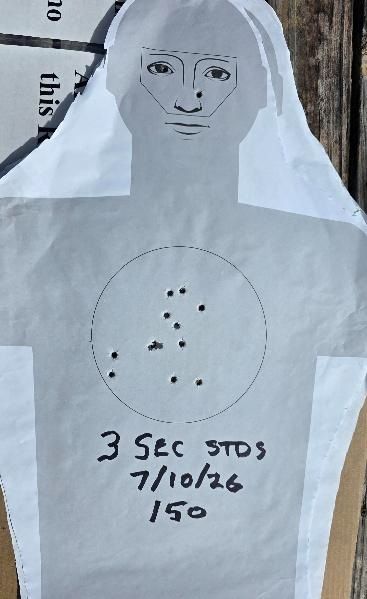
This drill is intended to be shot on a Rangemaster Q-5 or Q-6 silhouette. The chest ring and the head ring are 10 points, any other hit above the belt line is 5 points. If you use an IDPA target, the chest circle and head box are 10 points, the C Zone is 5 points, and the D Zone is a miss. 15 rounds total, possible sore of 150 points, 135 (90%) or above is “passing”.
Stage 1: Start holstered, concealed. On signal, draw and fire 4 rounds, freestyle
Stage 2: Start gun in hand, dominant hand only, at low ready. On signal, fire 3 rounds.
Stage 3: Start gun in hand, in non-dominant hand only, at low ready. Fire 2 rounds on signal.
Stage 4: Start gun in hand, at low ready. On signal, fire 2 rounds to the chest and immediately fire 1 round to the head. Run twice.
From Tom Givens’ statement in the newsletter following the Drill of the Month:
Distances Involved in Self Defense Shootings
“The DEA in 2007 had 44 incidents in which shots were fired against criminals. The average engagement distance was 14.6 feet. The typical American sedan is 16 feet long, so we could just say, about a car length.
“In the case of our students who had to shoot in self-defense, the distances involved were:
Contact distance 4%
3-7 yards 91%
Beyond 7 yards 4%
“The 3 shootings beyond 7 yards were at 15,17 and 22 yards, so some work at that sort of distance is needed, but not a lot.
“So, we put the vast majority of our effort in class on fast, reliable vital zone hits at the 3,5, and 7 yard lines, with a heavy emphasis on 3-5 yards. Three yards could be classified as conversational distance” and is the zone in which we normally talk to strangers. Five yards is essentially one car length. 7 yards is across a large room. If you think in those terms, the reason 91% of our shootings took place at from 3 to 7 yards makes a lot of sense. Keep this in mind when structuring your practice sessions.”
-- Tom Givens, Chief Firearms Instructor, Rangemaster Firearms Training Services