
In the mid-year, as we approach the 250th Anniversary of Independence and wonder about the future of the republic, the world of defense shooting continues to progress.
For example, one problem with typical shooting exercises, training and qualification is the use of an auditory signal – verbal, a whistle, the tone of a timer – to start shooting. That’s not how it happens on Planet Earth.
Operationally, you respond (ideally and ethically) to a visual signal and a visual identification of an imminent lethal threat. The old gag was that the cop would draw, fire a cylinder of ammo, reload and repeat, every time he heard a traffic cop blow a whistle.
That’s not true, but using a sound stimulus to commence fire is about like a K9 doing bite training and getting “sleeve happy.”
There are turning target systems, complex and expensive. Video simulators like the old FATS simulator are similarly complex and expensive.
Recently, John Hearne displayed a video demonstrating the use of the DADBODD.
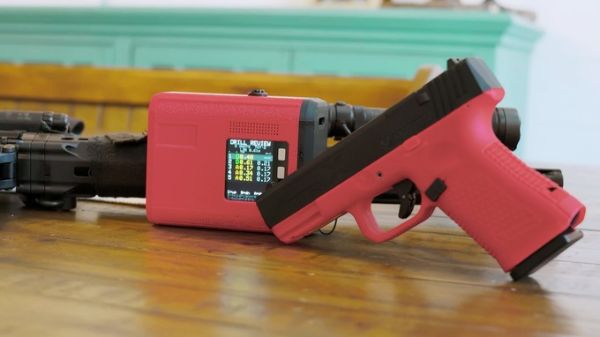
Bad joke, that name, but it stands for “Defenders And Disciples Behavioral Optical Decision Device”, which “… is a visual stimulus shot timer for firearms training.”
Being a shot timer as well as a visual start signal, it can be set for an ending time, a “stop signal,” and display any shot fired after the stop signal.
Consider that: a visual start and stop, just like on Planet Earth (in lieu of Range World). You have to stop shooting when the aggressor is no longer a threat.
Costing just under $200, it’s cheaper than a turning target system and has the advantage of displaying for the record any shots over time –when the threat desists.
It can also be used in dry practice using the the Mantis TitanX GLOCK 19 Style Laser Training Pistol (reviewed here).
According to information from the “kickstarter” page, “The DADBODD is a handheld visual stimulus shot timer for firearms training. Instead of a beep, it uses a laser (colored light that tells you when to shoot, when to stop, and what to do in between).”
The “course of fire” isn’t scripted; you don’t know how many hits you can get from the appearance of the laser on the target to the time the light goes out. Besides, you have to see the stop signal; if you’re shooting with a focus on the front sight, you may not stop in time.
We’ll be watching this initiative.
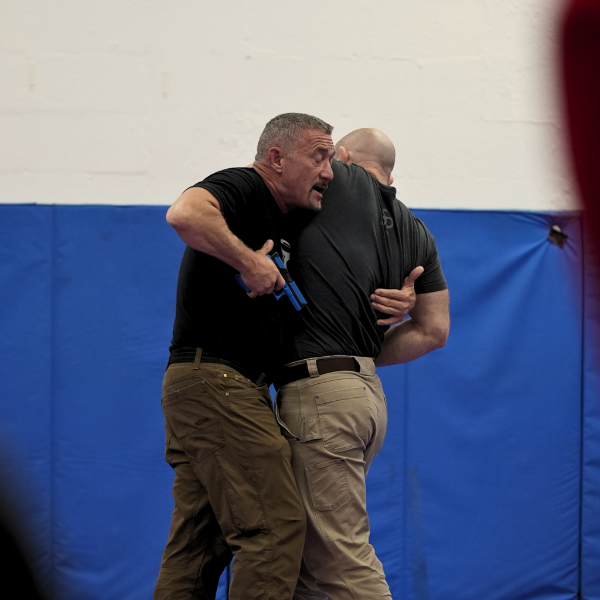
A current standard for shooting from retention is shooting “in the clinch.” The shooter is in an entangled struggle with “an offender,” has the opportunity to draw and does. Trying to get a hit high center is contraindicated due to the likelihood of deflection or a disarm. Drawing the elbow high and back, putting the hits in at low center of the target may “change the channel” and allow disengagement. This is called the “thumb-pectoral index” high retention position.
Craig Douglas (Shivworks) is famous for this type of exercise. He has been asked about the use of revolvers shooting from the high retention position and got to demonstrate it using a Smith & Wesson Model 610 10mm revolver. He put six rounds of 200gr. ammo into the target with the gun high against his body.
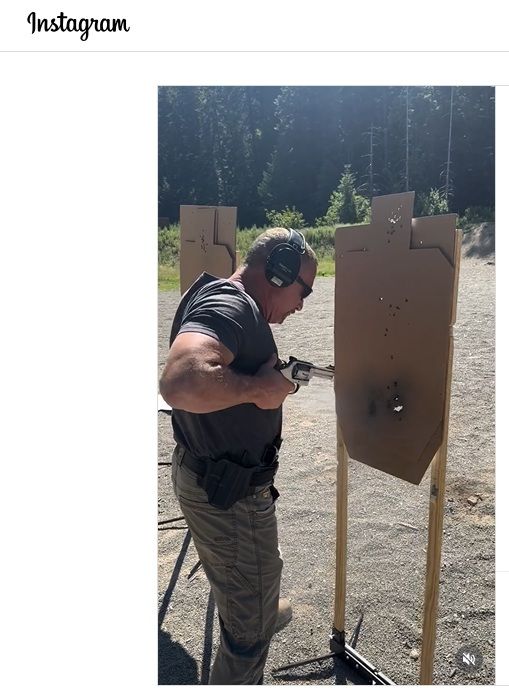
The issue is the flash gap, the gap between the turning cylinder and the forcing cone of the barrel. We know that gas – and potentially projectile shavings – exit the gun from the flash gap (hence the name) – so would you take frags from that?
He didn’t. He points out (correctly) it’s something to check with your gun and ammo – but if you’ve not shot from this position before in his class, you should consider everything in front of the muzzle – don’t let a foot get out in front of you (or anything else you don’t want punctured).
Consider it – but use due care.
– Rich Grassi