
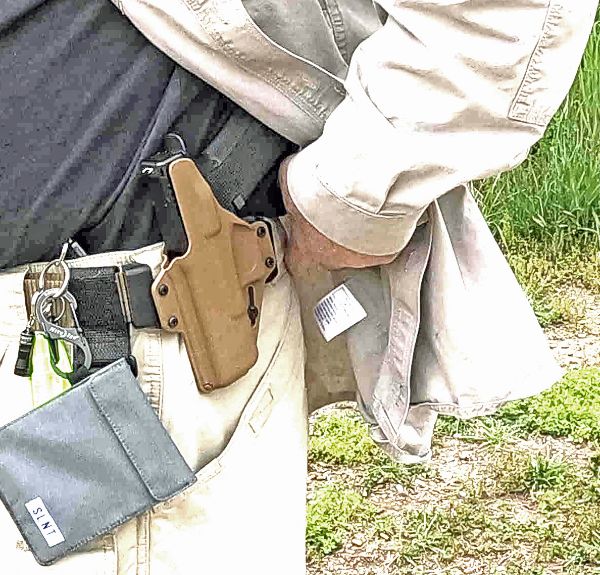
There are a range of reasons to set up a handgun rig for your less dominant side. For one thing, you can be a victim of an injury or debilitating illness that affects primarily your dominant side. It could be that you realize that a sidearm is a “handgun, not a hands-gun.” (h/t, Mike Rafferty)
Perhaps you are an instructor and you realize that, at one time or another, you’ll have to demonstrate for and coach people who favor left instead of the right (or vice-versa).
There were classes for instructors – and practitioners – where availability of holsters for both sides of the users’ bodies were required, such as Tactical Shooting Instructor, when taught by Clive Shepherd.
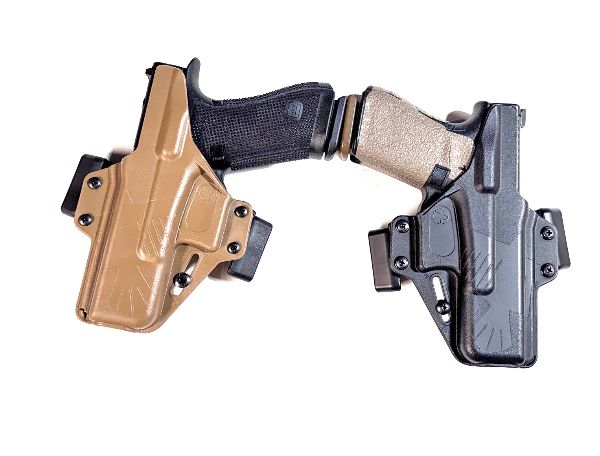
I’d fiddled with the concept on- and off since the 1980s. More recently, I ordered a spare Perun outside-the-waist holster from Raven Concealment Systems. For a reasonably priced rig, it has the advantage of shipping with hardware to make the holster useful for the right-handed and left-handed practitioners.
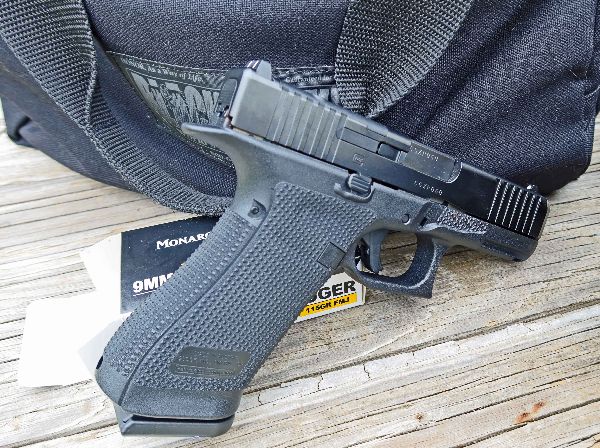
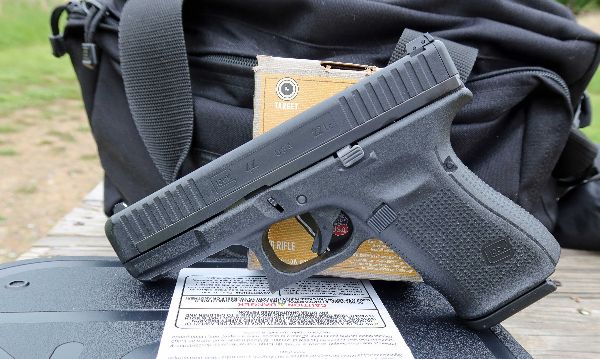
When the holster arrived, I set it up for the left side; I already had a Perun for the right. Along with the GLOCK 45 Gen6 and the GLOCK 44, I took both guns to the range.
The Perun is a high-riding modular polymer blend (a proprietary material) “pancake-“ style holster. The belt loops are separated, on the leading and trailing ends of the holster body. It feature a retention slider, high body-shielding “wings,” has an open muzzle, and is deeply formed to allow the use of pistol-mounted optics.
The holster body can have the (supplied) belt loops on the left side of the holster for right-handed users or on the right side, for southpaws.
The new holster, in FDE, now has the loops placed on the right side.
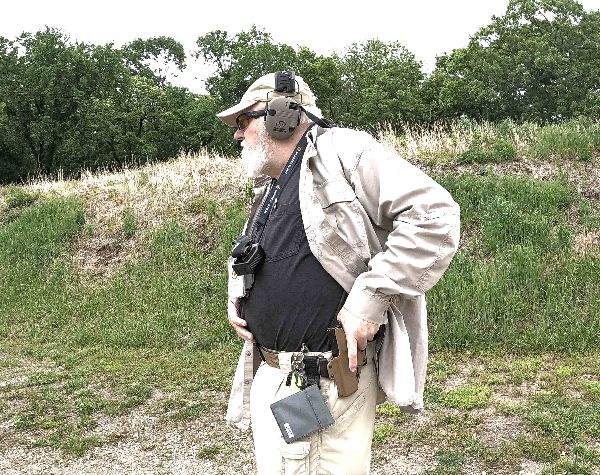
Using a B-8 (CP) repair center, I worked on the Baseline Assessment Drill with the new G45 Gen6. Sadly, I went over time on three stages. One was the “non-dominant” (right, this time) one-handed string. Another was the reload string and the last was the ten-yard “4 in four seconds” string. You’ll note that the over-time segments were all from ready – the holster wasn’t involved. In one case, my dominant hand was involved.
So that’s not “handedness,” that’s just a bad day.
From there, I moved to the rimfire to do single hits from the holster at about 25 feet from a clean repair center. I found, using a remote camera, that I was “scooping” and not drawing the gun straight up and out of the holster to press out onto the target. While it’s quick enough, time is burned up because the gun’s not arriving at the eye-target line consistently.
Time for dry practice, then going back to basics in live fire.
I was also failing to get a solid firing grip on the gun while it’s in the holster – that’s not a holster problem. The Perun is well designed to allow a full firing grip while the gun is in the holster.
Using the G44, I was running just over two seconds on drawing from concealment. Starting with my hand on the gun while the gun is holstered – as one might do when in an uncertain situation, but it’s not clearly a “guns-out” scenario – I was hovering around 1.6 second for a hit.
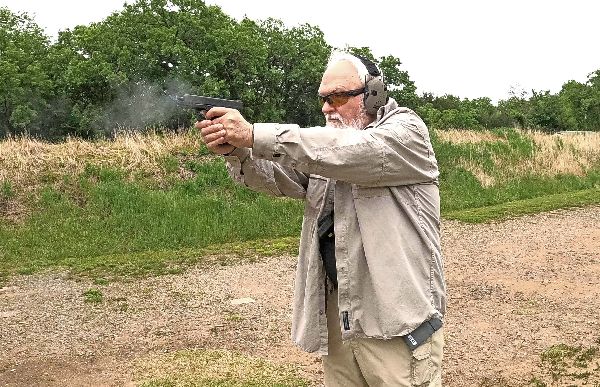
I moved to the “demand drill” – aimed in, finger on trigger with the slack out. The aim is to cut the tone from the “delayed start” on the timer in half. I had no trouble making the hit in .16 second – so the problem was the sights not arriving in the eye-target line in time.
That’s where I need to work.
It’s been a long time since I did dedicated work with the non-dominant hand as far as gun handling. I usually shoot half of the NRA Short Course or FBI Bullseye Course left-handed. The shooting part is okay.
It takes more holster drills to fix.
– Rich Grassi