
In wing shooting, a critical aspect is the mount – bringing the comb of the stock to the cheek under the dominant eye, bringing the gun to your eye line, not ducking your head to see the bead.
In riflery, when crossing a plain in search of small varmints for example, the technique is largely the same -- as it is in combat. Bring the rifle to your eye, don’t duck down to the rifle.
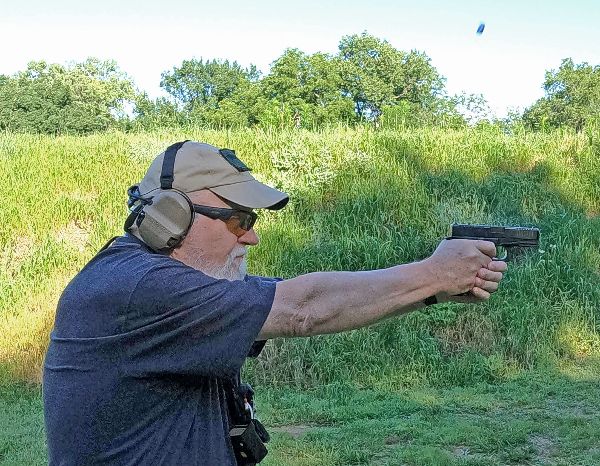
When shooting a handgun, according to an aged document from the American Pistol Institute (now known as Gunsite Academy), the plan for the 250 – Defensive Pistol included students beginning range experience with the mount.
As there are less points of contact with the handgun than long guns, you could argue the mount is more critical. It’s certainly critical when learning the gun.
Some will decry this beginning as “range world,” alleging that one can never do this operationally. Is there something to this? It seems a bit like using the sights. Walt Rauch once told me that the sights on a handgun are like the training wheels on a child’s first bicycle; once you learn the mount through extensive practice, the sights confirm your hold.
Before he told me this, Jeff Cooper noted (in writing) that the sights “verify” your hold. We’re talking about defense use of the pistol, not ISU or the National Match. While a grounding in classic pistol competition is a good thing to have – especially to learn discipline, patience and focus – you can go from defense or action pistol games to classic target work. You don’t have to do it the other way around.
This issue arose for me because I shoot such a variety of handguns for purposes of writing features. As I don’t get to concentrate on a single make/model/type of handgun, I never seem to improve in shooting them.
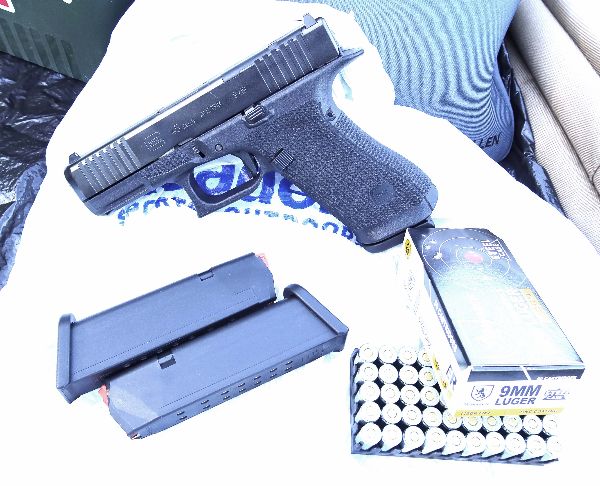
That was the case with the GLOCK 45 Gen6. In spite of the contrary opinions of some who are still operational, I found the Gen6 to be enough different from previous versions, that I was addressing the piece inconsistently.
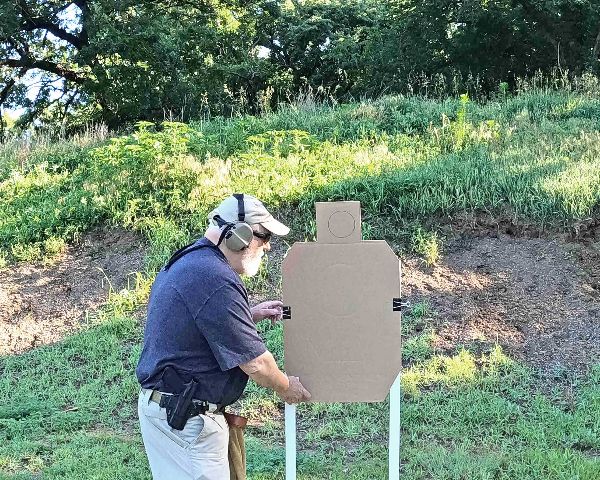
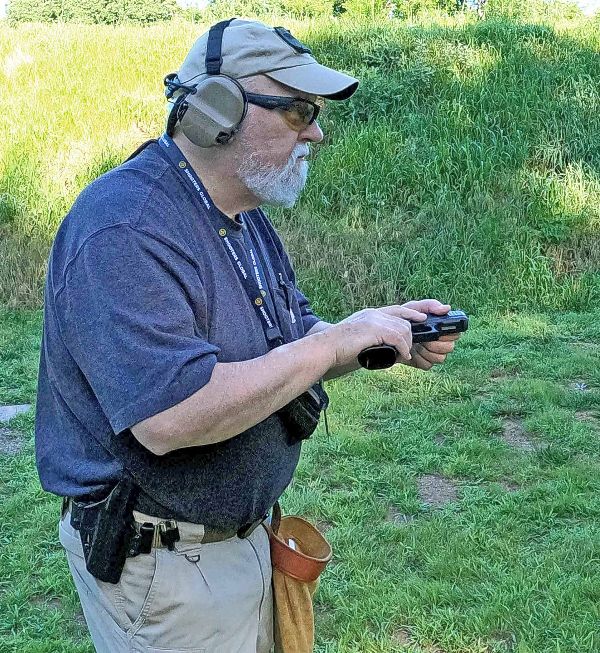
Back to basics – I took some range ammo, an outside the waist holster and an IDPA target to the range. When there, I went back to TD1 of Defensive Pistol.
That starts with dry practice – on the range. A great place to do that, if a live round wanders into the chamber on its own, I’m geared up with eye- and ear-pro. Part of the dry practice is from a real low-ready. As I get wired into the process, I do the “eyes-off” exercise. As the gun begins to move, I close my eyes, snap on the target, then, without moving, look to see where the gun is.
Think of a “moving natural point of aim.”
From there, I try a three- round cloverleaf from fifteen feet. That reinforces what I’m doing with the trigger and gives me some noise. I unload the piece and holster work begins with a number of reps of Count 1 – grip. Both hands move, the non-dominant hand moves up along the body while the dominant hand gets a firing grip on the gun in the holster.
After a dozen or so reps, I move to grip, clear, rotate – and do that for a number of reps. Finally, the completed draw – eyes off as I grip in the holster – bring the gun up and snap in blind.
If there are changes to be made, it’s like finding natural point of aim; I move my feet until the gun ends at the eye-target line when the trigger is pressed.
From there, it’s single hits to the head box followed by singles to the center -0 using the “eyes off” procedure.
Remarkably, all but one of the hits were in the -0.
From there, I moved to pairs.
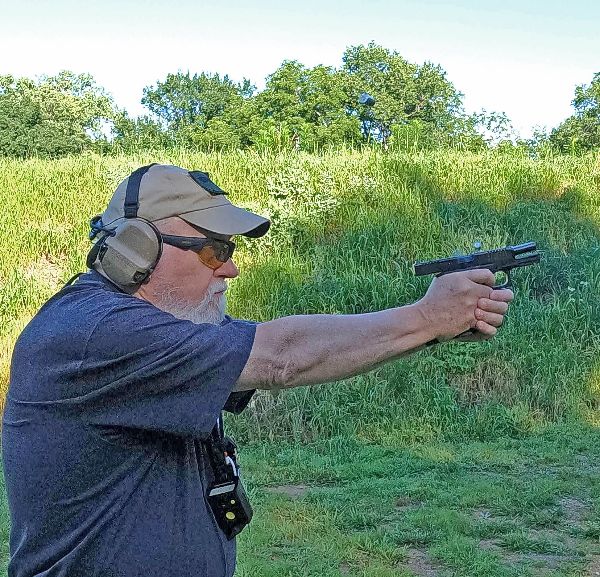
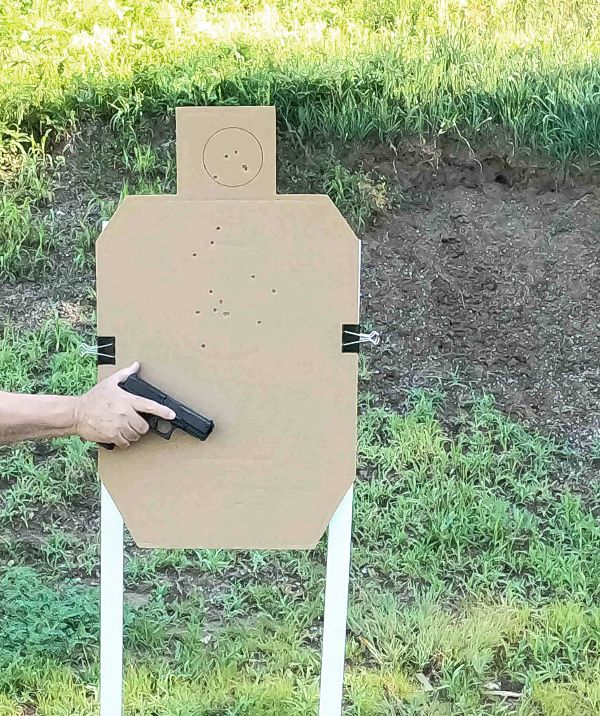
There is a timer involved. I check my times to establish a baseline of performance, taking notes to compare at a later time with more practice.
If this sounds boring, it’s not boring to have a decent target. This isn’t a precision group target, pretty for the pictures – it’s coarse accuracy at an operational pace. Still, it’s rewarding to see the results of dedicated practice.
At the end, I slow down for some precision work before leaving the range. I want the last press in my memory to be a precision shot, perfectly performed.
– Rich Grassi