
Lots of water passed under that old bridge. Looking bad and blowing the dust off, it’s interesting to see how things have changed.
I’d not say progressed; like any other period in human existence, we’ve moved a ways forward and slid some back.
In going through old files, I found a clipping from a newspaper – a real, dead-tree, paper-printed document that let people know a little about events in their localities before the advent of digital media. The pre-GWOT coppers (by around 20 years and change) weren’t wearing external vest carriers, electronic-discharge restraint devices, nor a box+ of ammo between the cargo hold in the gun plus spares.
It’s a clean look, less junk. Looking carefully at the non-digital image I have of this shot, I can see the Condition-1 Colt Government Model, customized by Bud Price of the Western Gun Exchange, in Miami, OK. The gun has a BOMAR rear sight, ramped front sight, blue slide over a hand checkered, hard-chromed frame. I believe he inscribed “PRICE” on the bottom rear of the slide on the inside.
There’s also the loop of a sap visible, carried “AIWB,” if you don’t mind.
That seems like such a short leap to a double-stack 1911-ish 9mm single-action hammer-fired pistol, as seems so popular today.
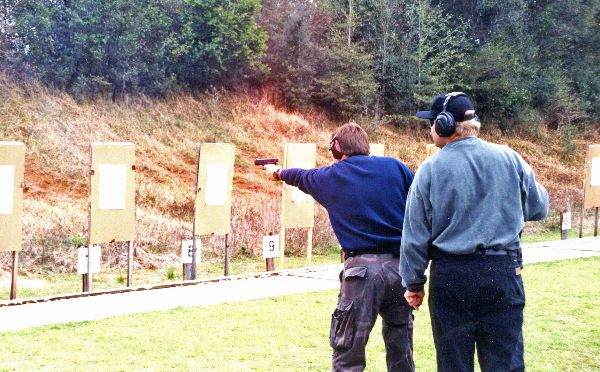
Along with the passage of time is the passage of friends. The image above is one of Marty Hayes at the American Society of Law Enforcement Trainers event in Mobile Alabama. He did a set on their master-level standards and people got to try their hand at it – individually.
If you want to know what pressure is, that’s it.
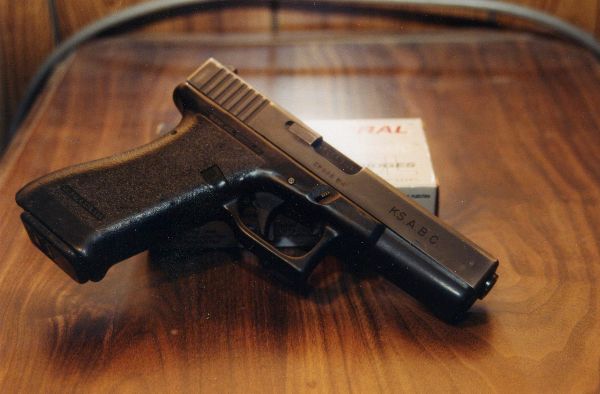
A way of looking back and making sense of the past is from artifacts. This is a second-gen GLOCK 17, marked for the Kansas Bureau of Alcohol Beverage Control. Having been retired, the gun was purchased by a then-employee who went on to carry it during a stint working narcotics in a sheriff’s department.
When fired on the range one qualification, it seemed a bit sluggish and my friend Mike Rafferty opened it up. It appeared that it hadn’t had an annual inspection in a decade or so and that it lacked “updated” parts. Mike fixed that, cleaned it and the gun continued on.
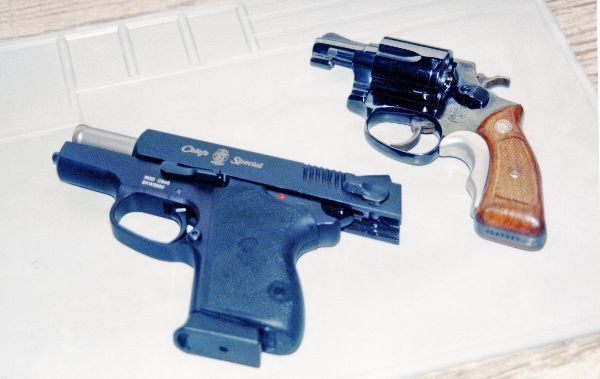
When gun companies re-use names of classic products they made before, it gets confusing. At the top of the image is a Chief’s Special – a “real” one, Model 36, square-butt 38 Special. That was the kind of Chief’s Special I’d been used to – so named because IACP was asked to name the new five-shot 38 back in the 1950s.
The gun below it in that image is the CS45 “Chief’s Special.” A low-capacity, lightweight pistol that came out late in the Third Generation of S&W DA autos, we looked at it as a compact form of our issued S&W M4506-1 pistols carried in uniform. It appeared close to the end of our time with the S&W autos and was never adopted.
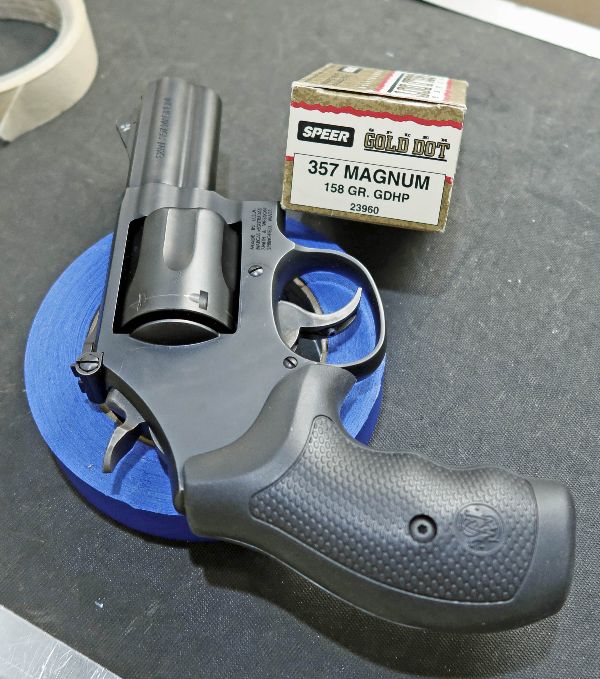
A Combat Magnum is still being made, this one a 3" M19 Performance Center Carry Comp. Some ideas are just too good to pass away.
Finally, back to my first cop job, a press clipping from when I was caught assisting the ambulance – the city police ran the ambulance in those days - by a local reporter.
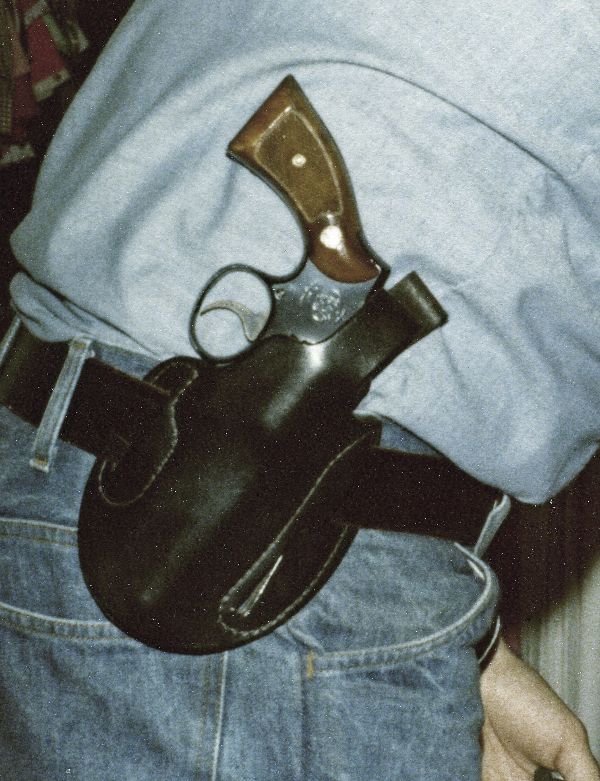
Looking at the photo, I see a six-inch revolver in that holster – a Smith & Wesson Combat Magnum. The holster, a Bianchi high-ride, left the trigger exposed.
We didn’t know any better.
The gun, I well recall, was loaded with Winchester 125gr. JHP 357 Magnum ammo. It was backed up by a pair of speed loaders and a pocketed Bianchi Speed Strip with six rounds of 357 Magnum KTW ammo. That was before CBS decided they were “cop killers.”
No optics, no patrol rifles. There was a Remington 870 shotgun with 00Buck in the car. It was in a locking rack overhead on front of the barrier between front seat and back.
I’m not saying they were the good old days – it wasn’t the land of milk and honey - but those days are a part of history. And what you have now is built on it.
- Rich Grassi