
If you just go to the range to turn money into noise, this feature isn’t for you. Likewise, if you just shoot in a way in which you guarantee your own success, this may be of small interest. For those seeking something in the way of self-improvement, here’s a tip.
I went to the range early one morning, arranged a (repaired) target, got the Shooters Global SG Timer GO fired up and went to work on a drill that starts easy and gets less easy.
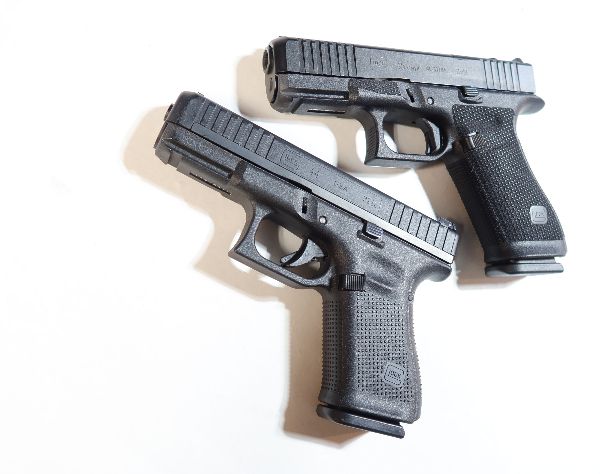
The guns I used included the GLOCK 45 Gen6 and a GLOCK 44 (22 LR). The holster is strong side inside-the-waist worn under an unbuttoned shirt. (The shirt does not clear quickly like a “photographer’s vest,” as it clings to the hand clearing it.)
The drills I shot included the Safariland 3-second duty holster drill (at 13:23, here), as demonstrated by Scott Carnahan in the video. The distance was 7 yards, and the target an 8” bullseye target (left over from another shooter and re-faced with a Shoot-N-C 8” bullseye from Birchwood-Casey).
The target he shot was larger – but, in his defense, the cluster he shot was smaller than my efforts too. Beginning with a single hit from the holster, in the required three seconds, you repeat with a pair, then three- and so on, attempting to get six hits in three seconds from the holster.
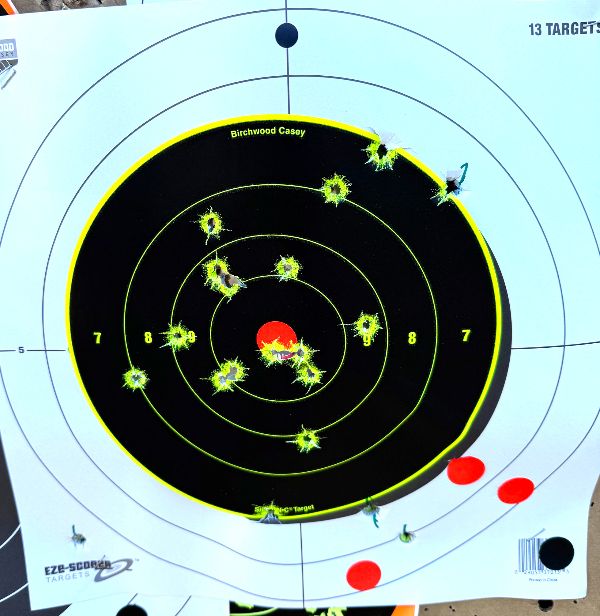
I started with the Gen6 9mm. It was a miserable start, as my timer was showing first round hits in the vicinity of two seconds. That’s a long time, but my aim was to keep the hits in the center of the bullseye.
If you watched the video, you see the drill (conducted with a duty holster, using a larger target – that Scott used very little of ..) involves setting the timer to a par of three seconds. On the tone, draw to a single hit. The second time, you draw to a pair. You continue until you get six hits on target in three seconds.
I didn’t do that, stalling at around 3:58. There was a single hit off of the bull with the 9mm, still on paper.
I followed that with the G44. From the training effect, times to first hit hovered around 1.5 seconds. Due to a relative lack of recoil, making six hits in three seconds wasn’t a chore – but it shouldn’t have been with the 9mm either.
It’s the cold performance that counts.
For those who shoot Bill Drills (that’s what this is) in sub-2 seconds, I’m not doing this to practice for USPSA matches. I’m trying to improve draw performance for personal protection, a different thing. When the time between shots fired goes under .3 second, the ability to assess what’s happening in front of the gun – so you can stop shooting – is compromised.
That’s not a good thing on the street. The key is to find the balance between solid operational speed with the ability to see what’s happening downrange.
I find the 3-second duty holster drill to be more important when working with a new holster – or when trying to sharpen my performance when drawing from a holster. More than an assessment, it’s practice.
I followed that with walk-back drills – starting at 20 paces, checking the target after every string – to “get my steps in” – then backing up to a further shooting position if I’m successful.
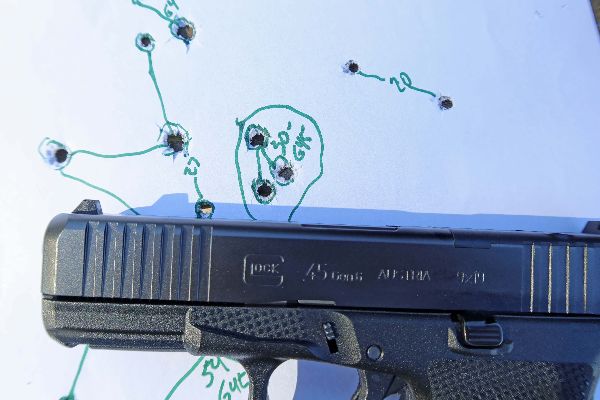
I used a target printed on an 11”x17” sheet of paper, face down, as my aiming point. Beginning at 20 long steps from the sheet, I put a pair of hits side-by-side, center, in 1 3/8” with the G44. Backing to 27 paces, I fired a 2 ¼” group, a vertical string. At forty paces, I put five hits low and left on the sheet in 5 ¾”, with three hits into 2 ¼”.
Thus far, I’d used the bottom half of the page, something that would continue with the new G45.
Changing to the 9mm, at twenty paces, I put two hits center in 1 7/8”. At 30, I put 3 hits into 5/8” – a fluke, as that is tighter than I can see, let alone hold.
Not satisfied with that, I stepped back to 54 paces and put four of five hits into 3”, with the fifth round going low for an extreme spread of seven inches.
That was a failure to concentrate on keeping still those three non-trigger fingers during the press.
Still, I saw where I need work. And so, I shall.
– Rich Grassi