
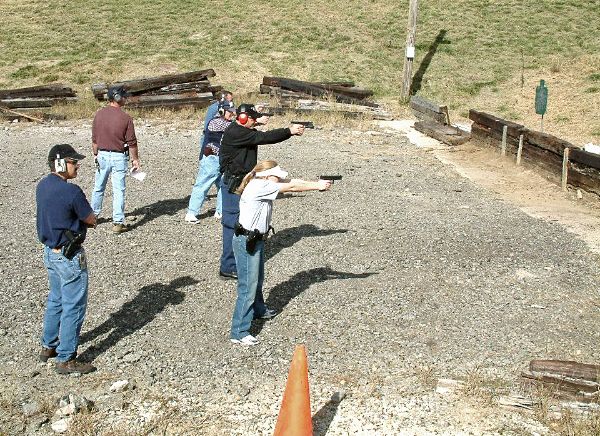
To provide context, I’ve been out of the training game for around 20 years. I believe others have covered this subject, but I went over old notes on designing a police handgun qualification and here are some observations on development of a qualification course for cops.
First, the current age has states enforcing their own course of fire – or at least minimum skills tested – over letting each agency do its own thing. By doing so, state training commissions have put themselves potentially downrange of legal jeopardy.
That matters more to the taxpayer who foots the bill for all that foolishness and I don’t believe it’s likely that individual members of the commission will be personally jeopardized.
We can work around that and smart agencies (if any are smart) do so.
Next, I see qualification not as training (it isn’t, though it’s counted that way), nor practice nor anything else but checking a box. If the law requires annual qualification and tasks the commission with mandating what the course is, it has to be done. Where it rests on agencies is treating a qualification as collecting evidence for court – potentially.
The reason (if you can call it that) for qualification, after legal mandates, is to demonstrate that your officer was capable and competent in the aftermath of a shooting. You may use it to divest yourself of the officer (he showed he could do it, but failed on the street when it was real), you may use it to prove you provided adequate training (in a civil rights action), or you may use it in defense of the shooting.
The reality is that we don’t know how many times – if ever – the existence of a successful qualification was a critical part of a litigation. Before anyone starts preaching chapter and verse, I’m referring to trial courts.
How do you “work around” state mandated quals? First, you do them and document them more than the state requires: if they require a Pass or Fail, do what the state says but keep a numerical score. You do this so you see who’s struggling.
That means we keep score. A “pass-fail” system is nonsense. If the course mandates that 35 holes have to appear in a target shot at with fifty rounds and you stop counting when you get to the 35th hole, it's counted as a “pass.”
If someone shoots 50/50 and they get the same “score” or are “just as qualified” as Fred when he shot 36/50, that’s a problem. You can’t look through the record and find the marginal shooters. Someone might find that indifference, even negligence.
You’re putting them on the street with guns not because you believe they’ll never need to shoot. You’re hoping that none of them will have to shoot while you’re in charge.
Better you should play the lottery.
As to working around the state, after you’ve done their required qualification for the record, do your own. The state’s qual says you’re qualified to have the job in that state – not that you’re qualified to work in this agency.
In your own efforts, insist on a 100% standard; that’s for hits, not score. Every round fired in qualification has to hit the target somewhere. If it’s a B-8 bullseye and you fire thirty rounds, there has to be 30 holes in that target – be accountable for every round fired in qualification.
Next, there have to be job specific elements. Each phase tests one or more fundamental job-related skills.
Train them to meet the standard. If they hit 100% and the score is high enough, document it as “qualification.”
If not – work with them, documenting it as training, not a “re-fire.” Calling it remediation isn’t the best motivator either. Get their skills in line so they can perform the test.
Then, when it’s fired with 100% hits on target, high enough score, document it as qualification.
That’s (largely) a Clive Shepherd rap. I adopted it because it makes sense.
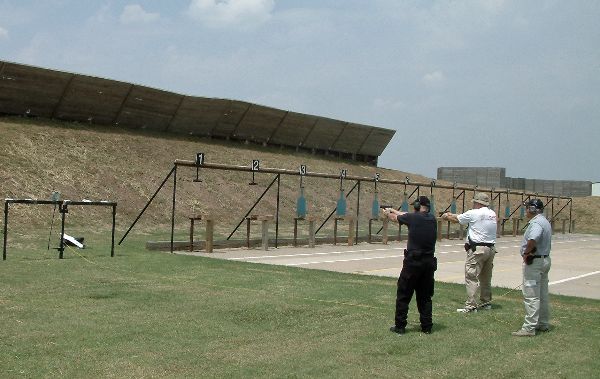
Training, according to Pat McNamara (seen here discussing working with bullseyes) must be comprehensive, systematic and progressive. Until you find your level of accuracy by testing you don’t know what’s not working – and you can’t fix it.
Also, I’m not a fan of discipline = punishment without discipline including rewards for positive behaviors. There should be some recognition of “high shooter,” as well as “most improved.” That can be a service bar, a posting to the bulletin board or agency email – anything to let people know that their efforts will be rewarded.
For an example, see the LAPD Bonus Course.
Take care of your people. Insist that they exceed standards. Lead by example.
And create new leaders. We’re going to need them.
– Rich Grassi