
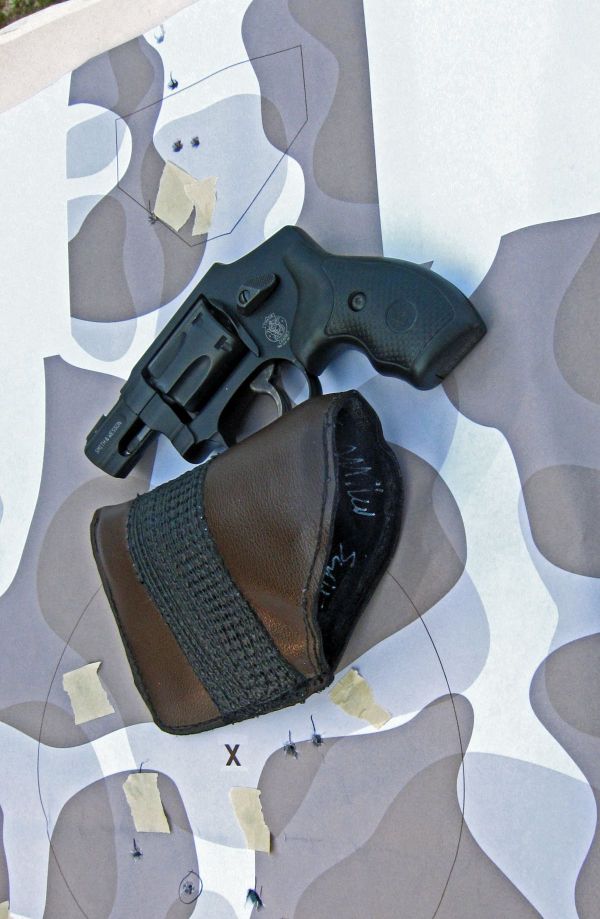
Without going into why – “what is tactical about a snub revolver in 22 Magnum?” – let it suffice to note that people who have physical limitations due to age and various medical infirmities might find their needs best served by a light recoiling, easily concealed gun.
Even tactical types get old and infirm. I’m not sure they lack a need for adequate self-protection. As to the “power” of the 22 Mag from a short barrel, let’s look back in time:
“The one light loading that I would like to see would be the airweight (sic) model Cobras and Chief Specials chambered for the new .22 RF Magnum load. This is a wicked little cartridge and would add little to the weight of the light models (five .38 Special cartridges weigh about as much as the Chief airweight (sic)), and would make a wonderful addition to the "hide-out" field, particularly for officers working in hot countries where usually a coat is not worn during the hot summer months.” (p.77) – and –
“A recent letter from Doug Hellstrom, Smith and Wesson's dynamic young executive vice-president, says that they are working on the problems attendant to marrying the .22 RF Magnum to the Chief airweight (sic)—and there are lots of problems. Aluminum cylinder and barrel with steel liners are indicated to keep down weight. The big problem, however, is devising a method to keep the hot gases from eating through the aluminum frame above the junction of cylinder and barrel. If this problem can be whipped it should result in the perfect hideout gun. It will not only outreach a switch blade, but will pack plenty of close range authority into an easily carried and concealed package.” (P.79) © 1965: Jordan, William H. "Bill," No Second Place Winner.
If you don’t know who Bill Jordan was, he was Assistant Chief Patrol Inspector of the U.S. Border Patrol, an experienced lawman and game hunter. He was a WWII Marine, veteran of the Pacific Campaign. To say he’d participated in and seen a lot of action, including shootings of people and game would be an understatement. If he thought a snub .22 Magnum was a good idea, I’m not going to call it stupid.
So why is this relevant now? I recall this because a reader, interested in the 22 Magnum snub - his is a S&W Model 351C – asked about accuracy I’d experienced in my own sample … from a 2016 feature.
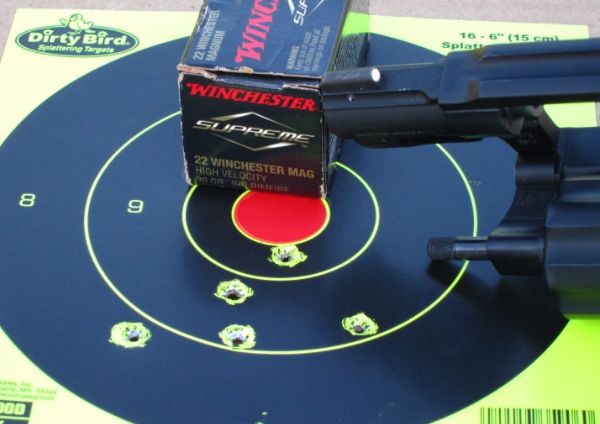
I no longer have the ammo in question and ca. 10-year-old notes seem to have escaped me, but his question brought up an interesting point: is this revolver format still available for those who’ve more recently come into infirmity or senior-citizen status?
Let’s look.
I’ll start with a gun I’ve not been able to source for examination: the Taurus 942, an 8-shot 22WMR revolver. It weighs in at the portly side of the 22 Magnum lineup at over 17 ounces. With the two-inch barrel, it’s the capacity champ with eight rounds of cylinder space, likewise a maximum for this class of micro-cannon.
Unlike others of the field, the Taurus 942 has a drift adjustable rear sight that matches with the ramped front blade. The stocks are standard-Taurus rubber, meaning they are surprisingly comfortable for shooting, though may complicate pocket carry.
I have the steel frame 22LR version of this gun and it works fine. It’s a bit much to carry, but my 22 is heavier, not the Ultra-lite. This Magnum, linked above, has an aluminum frame with the barrel and cylinder fabricated from steel.
They don’t show a stainless version of the 942 Ultra-lite in 22 Magnum.
Staying with the heavy weights, Ruger still shows the 22 Magnum LCRx with “limited availability.” I’m guessing they don’t make many. Weighing 15.4 ounces, this comes in second for heavy weight. It comes in at the bottom for capacity; the LCRx in 22 Magnum holds only six rounds. I asked about this some years ago and it was said that extraction issues with the long, straight 22 Magnum case were lessened by having fewer cases to drive out after firing.
This is another one I don’t have to try. I’ve made rather extensive use of the LCR/LCRx line in the past and expect no problems from this one – if you can find it.
The S&W Model 351C – a Centennial configuration – was the subject of the reader’s question. The Centennial, a brainchild of Rex Applegate, is a double action revolver with a concealed hammer. Fitting a wide range of holsters, the 351C has a large white dot for a front sight. I’ve had this sample for over ten years.
A seven-shot capacity and a ca. 11-ounce weight makes quite a package. The factory stocks were rubber and the trigger was smooth, featuring no grooves on its face. The action is stiff, appropriate to lighting rimfire ammunition.
From the same maker, there is an exposed-hammer option, the M351PD. I’d turned my nose up at it as the Centennial line has concealed hammers, the better to draw from a pocket holster without snagging a hammer spur.
Trying the PD version was interesting. It’s a handy gun in its own right.
Aside from the conventional exposed hammer J-frame format, it features a U-notch cut into the top strap as a rear sight with a fiber optic front sight. It’s a very good sight picture for coarse accuracy.
How well do these things shoot?
Using the 351C, I used the Mika Pocket Holster to shoot Hackathorn’s Wizard Drill. It’s five rounds, spread over distances from three yards, to five, to seven and back to ten yards. You have 2.5 seconds per stage and, if shooting a pocket gun from a pocket holster, you can start with your hand on the gun in the holster.
I was down one, went over the head box on the first shot at three yards. After that, I settled in and shot the rest of the course clean and in time.
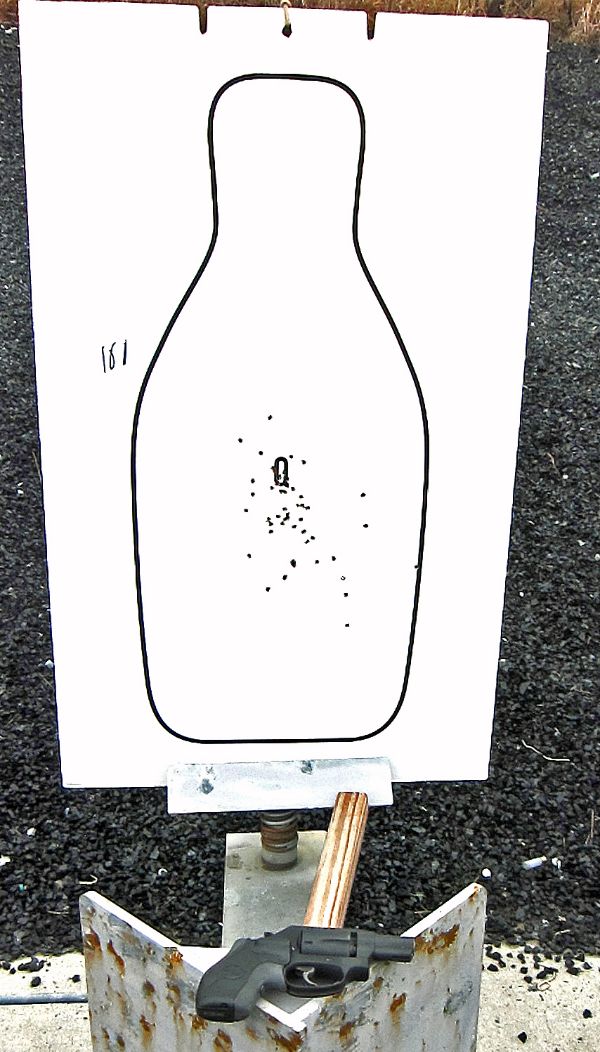
Using the S&W 351PD, I shot a retiree qualification course, for score, in front of the agency rangemaster. I shot CCI Maxi-Mag ammo and used a Galco Concealable belt holster (before the 2.0 version). Using this previous Concealable, the gun was virtually invisible under a shirt. I shot 100% -- barely – with a hit that wandered out to the scoring line and cut it.
The size of the group wasn’t small, but I was surprised at the central cluster in the target. I’ve shot larger guns with more dispersion.
Is such a small gun good for your use? I don’t know. As an extremely discreet deep concealment gun, it certainly has a place -- just as it does for very fast close-range engagement.
But it’ll still do the job at distance, if you’re up to it.
– Rich Grassi