
As most “entertainment media” doesn’t … entertain … and the only news is dueling knot-heads on social media, I was consuming information from small, non-corporate YouTube channels one evening. One is a product of Sheriff Matt Oller, duly elected in and for Audrain County Missouri. He discusses various firearms topics for the most part and I find his material interesting.
He has one about an appropriate home defense firearm because he routinely gets asked “what is the best home defense gun?”
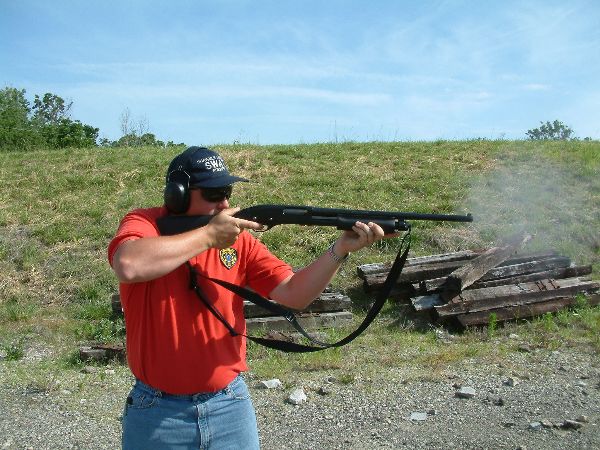
They didn’t ask me – it’s the one closest to your hand when you need it, if you care to know. His answer was the shotgun.
Having watched his video, I can debate use of the shotgun (need both hands for the gun, a problem with physical contact, “leading” around corners, etc.), I can argue against his recommendation of 4 Buck for ammo, I can even argue about what’s the typical visual target distance in a good many homes, but it’s what went unsaid that I choose to address.
If you have a firearm of any type for home defense, the most critical skill you can possess falls under RULE 4: Be sure of your target; visually identify it before firing. Know what’s around it, on either side of it; what’s behind it and what could step between your muzzle and the target.
How is that relevant? The pattern of a good number of home defense scenarios is less likely the home invasion while you’re in the family room watching a rerun of Deadwood. Mostly, people consider that it will be the “bump in the night.”
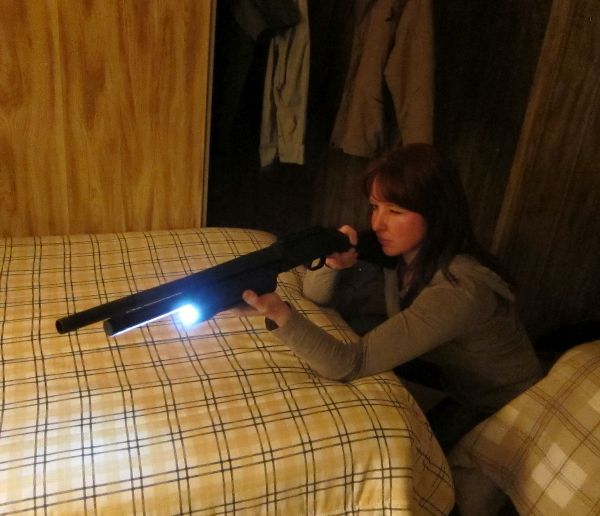
A light on the gun helps, but remember - it's no longer a "light." It's a gun. Wherever the light is directly, so is deadly force.
You’ve turned in. Roused by noises down the hall, you feel suddenly cold, your heart thumping in your chest. Swinging your legs out and touching the cold floor, you reach for the gun, and stumble to the hall. In the dimness, lit only by a nightlight near the floor and a bit of street light from outside streaming in a window, you see the human figure hurrying down the hall in your direction.
What do you do?
You sure as hell don’t shoot.
To continue the example, you’ve gotten to the bedroom door, see the figure in the dimly lit hall – and you shoot.
Was that a teenage son or daughter sneaking in past curfew? Was it your spouse who, feeling ill, went down the hall for a glass of water?
Shooting in that case creates a grief I can’t help you with. That’s not something I can put back together.
It must be avoided.
Consider Rule 4.
“But that’s a range rule.”
No, it’s a life rule. It’s one you accepted when you elected to be responsible for your own safety. It’s something that should be taught in schools – and I don’t mean “gun camp.”
How does Rule 4 help?
“Be sure of your target.” Be sure of what’s near it, on either side, what’s behind it; what could step between your muzzle and the target –
And what is that target?
Consider Cooper’s Color Code. It’s meant to lessen your reluctance to direct your muzzle at another human being. How is it that Cooper described that process?
In condition Yellow, you’re at relaxed alert. It’s impossible to do when you’re asleep, but you can easily stay in Yellow any time you’re awake. It’s what you do anytime you’re around people you don’t know. If you’re out in public, taking in a concert, shopping, taking a spouse to the hospital, traveling -- you seek to stay in Yellow.
It’s relaxed alert - it’s not stressful at all, but it’s just taking in all that goes on around you. You try to recognize people, some of whom you’ve not seen for years, before they see you. It’s a bit of a game -- but your intention is to see that which doesn’t fit.
It’s like you’re a patrol boat on the ocean, Cooper said. As you’re out “amongst them,” your radar is turning all the time seeking a potential target. It’s a nonspecific alert; while you haven’t detected any problems yet, you’re looking for anything that might require your “lethal attention.”
If something does create a blip on the radar, there’s something there. “I may have to do something about that.”
Until you can identify what that potential threat is, you move to condition Orange. Orange is a state of specific alert. You’ve identified a potential target but you haven’t decided to take action yet.
Once you’ve determined that it’s somebody that’s actually dangerous, you move to Red. Red means “fight.” You’ve already made the decision. Your reluctance to press the trigger is now much less. And now it’s up to your opponent whether to continue the act that presses the mental trigger that you have set.
If he takes one more step toward me, it’s done.
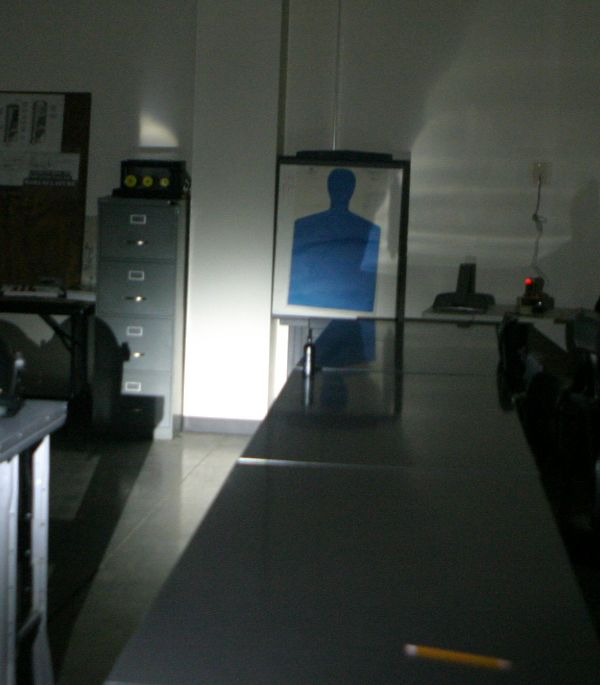
The gun-mounted light in this example is directed at the floor - not the target it illuminates. Using bounce lighting is helpful - but you could turn on a light switch or use a hand held light. Or just call out to see who's there.
Note that in all that discussion, acquiring awareness of a suspicious circumstance and determining that you may have to shoot is predicated on seeing what the problem is.
You never shoot at a sound. Visually identify the person and situation first.
You have the tools to do that and I don’t mean the latest sun-tan-causing super tactical gun-mounted light.
You could try your voice. The Tactical Professor, Claude Werner, arrived at the tactical solution: “Who’s there?”
If the answer is, “Daddy, it’s me,” put the fowling piece away.
– Rich Grassi