
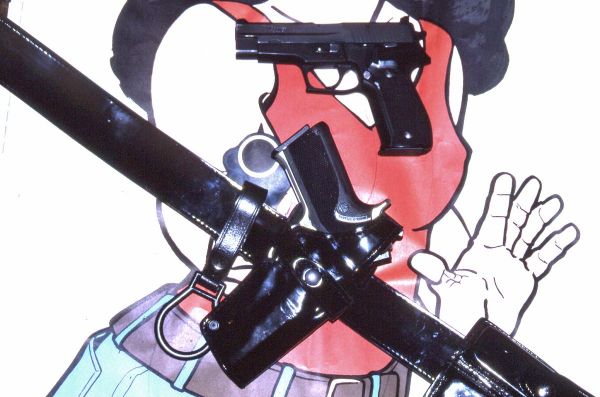
As far back as the late 1980s-early 1990s, the reliable police autoloader became ascendant. Above, the SIG P226 and S&W M4506 represent the 9mm vs. 45 Auto positions.
Sometimes, a glance back at history helps us better understand where we are today. People don’t remember that duty handguns weren’t always reliable, an era in which there were few types of handgun ammo available for use and that we’d just come from a period where duty pistols and revolvers had less-than-visible sights.
I used the following book in doing a research study for undergraduate credit -- Bristow, Allen P., The Search for an Effective Police Handgun; Springfield, IL: Charles C. Thomas, 1973. The topic of the study was equal amounts a search for ammunition and stopping power and the best format of gun to be issued/allowed to be used.
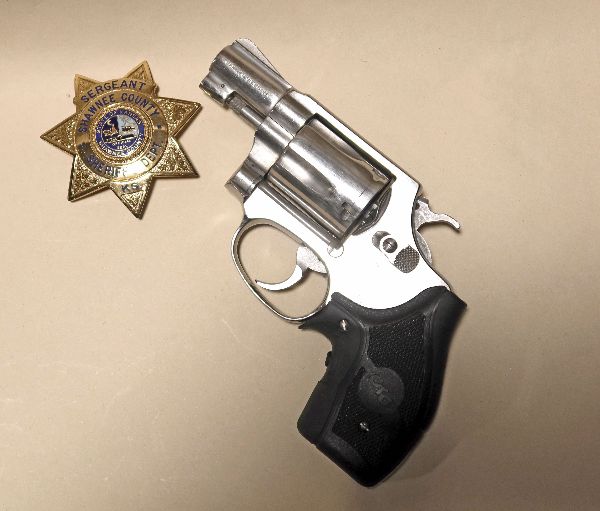
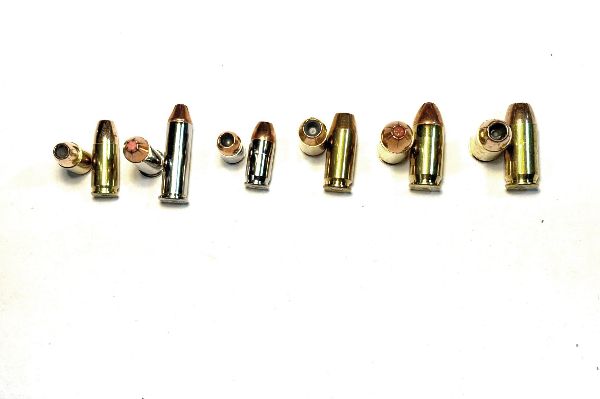
From the days in which the book was written, this 1980s manufacture S&W Model 60 represents an example of plainclothes/off-duty guns available. Below, ammunition choices per caliber became broader, with expanding jacketed ammo becoming commonly issued.
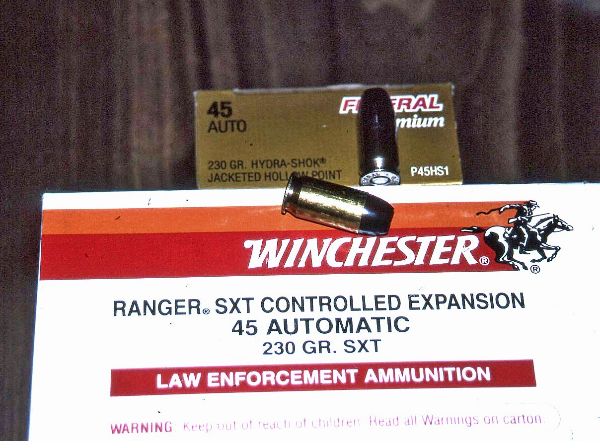
As ammunition was largely full metal jacket ammo for autos and round nose lead for the typical 38 Special revolver, the autos didn’t have much of a chance.
The issue of “ideal police handgun” plagued the police from the time that Teddy Roosevelt, Commissioner of Police in New York City, wanted his cops to be armed. In those days, it was more caliber than action type.
From the time that the NYPD sallied forth with 32 caliber revolvers, the discussion of gear over figuring out how to win gunfights began its torturous trail. It exists to this day, but the debates are more optics and what brand of gun – with the exception of the reemergence of the 1911, this time in a double stack 9mm configuration -- under glass.
The concern for years – culminating with the expansive studies after the FBI-Miami fight – was, so to speak, “handgun stopping power.”
In these enlightened times, there are those ahead-of-the-curve types who are relearning what shootists have known for a long time: there’s no such thing. You’re punching a bit of a hole into someone who wants to kill you. The extent to which the suspect displays full-rage behaviors, drug-alcohol fueled or not, determines whether the result will be someone who lays down, runs away, or charges into you in an attempt to exterminate you.
That should leave the discussion to form and function; do you “need” a lot of rounds and/or a quick reload, for example.
It’s educational though to go back in history and look through the intellectual gyrations trying to (in the words of Jeff Cooper) “make a silk purse from a sow’s ear.”
Of course, he was talking about magic bullets loaded into what he considered sub-caliber ammunition. We all know better now – until an anecdotal bit diverts us.
Like most human enterprises, the debate goes ‘round in circles, revisiting gunnies like a reappearance of a celestial anomaly -- a comet.
The fact is that just about any centerfire round – and even some anemic rimfire rounds – are known to turn the trick if you know how to shoot and how to fight. Additionally, there are times attackers don’t quit until they just can’t continue. Lots of damage can follow.
In Bristow’s book, he mentions the lethality of 22 rimfire ammo – it’s likely, as Chuck Haggard points out, that most uses of 22 ammo seem to be from easy-to-shoot 22 rifles, at near distances, often with a non-threat shootee.
What is causing the lethal result? (1) Precision hits into difficult or impossible to repair body parts, (2) the precision afforded by a rifle, with a barrel enough to get penetration of the little bullet, as well as the amount such a gun is fired without lethal intent (“practice”), (3) at close range – increasing accuracy while maintaining what velocity there is, and to a target that doesn’t know it’s about to be killed.
If there’s no body alarm reaction in the target, the sucker punch from the 22 is lethal indeed.
Still, with police handguns and similar, we often have a temporary stop, where someone will cease an attack before realizing they’re not dead – and renewing their assault. And that’s with modern, “it passed the FBI standards” ammo, let alone cheap range ball ammo.
For non-uniformed types (and non-police) these days, it’s more “what can I carry concealed while being able to shoot it well?”
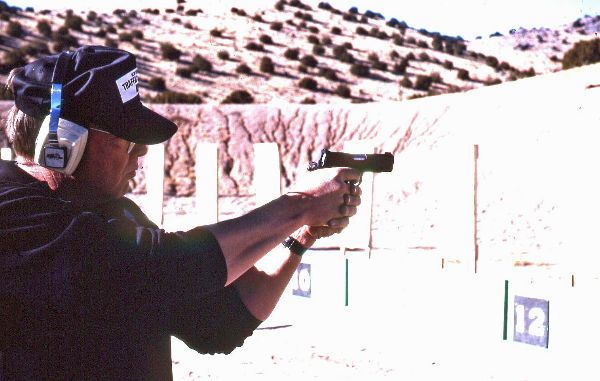
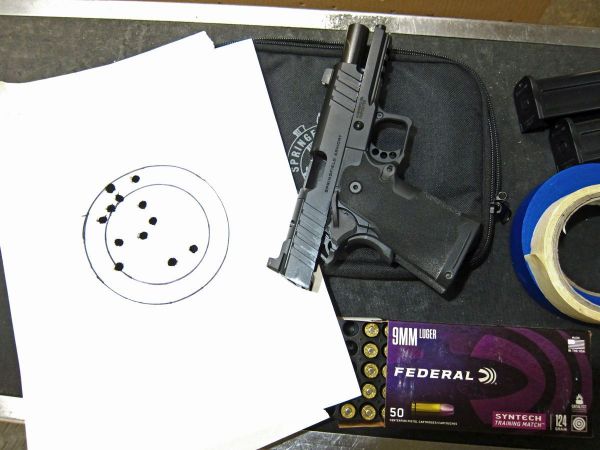
Where we were in the run-up to the 1990s in terms of police guns are shown by a modified 1911 above. Below, the increasingly popular double-stack 1911 is shown below in the form of the Springfield Armory Prodigy Compact.
You’re more likely to be spotted by the opposition – or a nosey HOA-type – than you’re likely to be involved in a fight. While notice of your condition isn’t often fatal, it can be troublesome and can bring serious complications to your social and professional life.
It’s better to be always armed – discreetly – than to be unarmed or to be clumsy in concealment.
As to the police handgun, it seems that the most likely issued gun is a modern striker-fired pistol (nearly all with polymer frames) or a double-stack 1911 (likewise, in frame materials), nearly all in 9mm. It seems that a few 45 1911s are hanging on in certain small agencies.
I guess Professor Bristow’s search is mostly over.
– Rich Grassi