
“Tao - … the source and fundamental principle of the universe, primarily as conceived in east Asian religions. The concept has meanings including 'way', 'path', 'road', and sometimes 'doctrine' or 'principle'.”
While perusing social media, I saw an image of text in a book (the post was from Flatfoot Solutions LLC on Facebook). Described as being from Keith Jones, Indianapolis copper and officer survival instructor, the writer described the rush to “new stuff” as follows:
But gunfights tend to be pretty low-tech affairs. Big city tactical cops will quickly tell you that a well-directed impact from a hardwood nightstick or a 12-gauge rifled slug works about as well as anything else, neither of which is new or high-tech. These men, who literally do it for a living, often pay scant attention to the cutting-edge developments in weaponry that become a staple of conversation for the rest of us. In their line of work, success is largely measured by how often they don’t shoot. (Emphasis added.) They know that survival depends on mind-set, tactics and marksmanship far more than slight differences in bullet performance. They know that, beyond a certain point, it doesn’t matter what kind of ammo you stuff in your weapon.

I really couldn’t have expressed it as well. This is clear confirmation bias at its finest, as that’s what I’m feeling right now.
I’m not out to teach you what to think, but how to think.
First, it’s not about anything new-ish … like “renewable energy” (sic), we’re not against innovation in the field of defensive firearms and weaponcraft; on the contrary, we’re all about it. Anything that makes us better at what we’re to do can be good – if we understand the costs and we don’t lose sight of sound principles foundational to tactics.
Tactics aren’t procedures, but a way of thinking. Consider mental conditioning and adjusting your mind to preparedness for battle.
We’re not out seeking battle (unless you’re a military asset). It’s quite the opposite for most of us. We seek voluntary compliance, in the police sphere, by getting and maintaining situational dominance. That aspect comes before your arrival to any particular scene; it comes from looking that long way down the road ahead and thinking “what if?”
As to the gun you carry – it’s your job to make it work. For many of us, it wasn’t discretionary, we carried what we were issued. That meant we had to find other ways to ensure our success in the field.
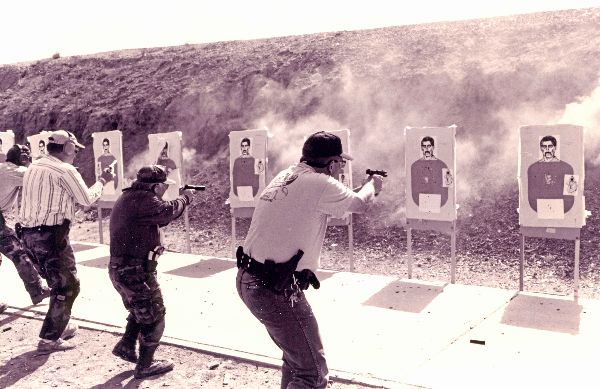
Part of that is relentless work on the hard skills – marksmanship and gun-handling – while polishing the rough edges on the soft skills – awareness, mindset and a tactical frame of mind.
If you’re like me, now gloriously and for many years retired from the job, my strategy is to avoid contact. That means that watchfulness and active listening are order of the day. If it looks (or sounds, or both) wrong, I’m heading somewhere else. I’m not tied to any piece of ground.
Yet.
Movement – in terms of evasion and escape – is my friend. What gun do I need for that?
Even when I was on the job, avoiding situations where I might have to shoot someone was high on my list of priorities. Thankfully, I was successful, though there were some close moments.
If you have to fight everyone you take into custody, you need to rethink your approach.
But, if force is called for, use enough force quickly enough and you’ll minimize the chances of injury to the suspect and yourself.
I was all about what was new or different from what the standard was. I’ve often bored people with the story of two uncles who were members of service – brothers, but in different agencies serving in different parts of the state, they carried exactly the same model of 38 revolver for duty, in uniform or out. Being better informed by Jeff Cooper, I tried to help them to understand … but they did fine with what they had.
When I was asked for a quote for a new book, the author questioned me about ammunition. Being much older by then and knowing that I know far less now than I did when I was young, I used my standard ammo evaluation criteria: ignition reliability, functional reliability and the load hits to the sights – in that order. Some penetration would help.
He was stunned, what about expansion, defeating barriers and such?
I’d just hoped that the user of the gun didn’t miss.
He was unhappy with my answer.
Moving back to the founding principles – hard skills, precision accuracy and competent gun-handling – it’s vastly more important than the “latest and greatest” gear that all the old hands joke about at SHOT Show.
Should we continue research and create innovations? Sure – do that.
Just don’t throw out the baby with the bathwater – we old timers are against forgetting lessons paid for in blood.
It’s disrespectful to those who paid that price if you walk into the same situation and get yourself killed or crippled. It’s disrespectful to the sacrifice of the still-living widows and orphans of those who taught us those lessons.
– Rich Grassi