
Massad Ayoob, on his Facts and Firearms video about “On Target, On Trigger is Wrong,” decrying finger on trigger while a person is “taken at gunpoint.” He makes salient points about postural instability and more – creating a shot recklessly fired.
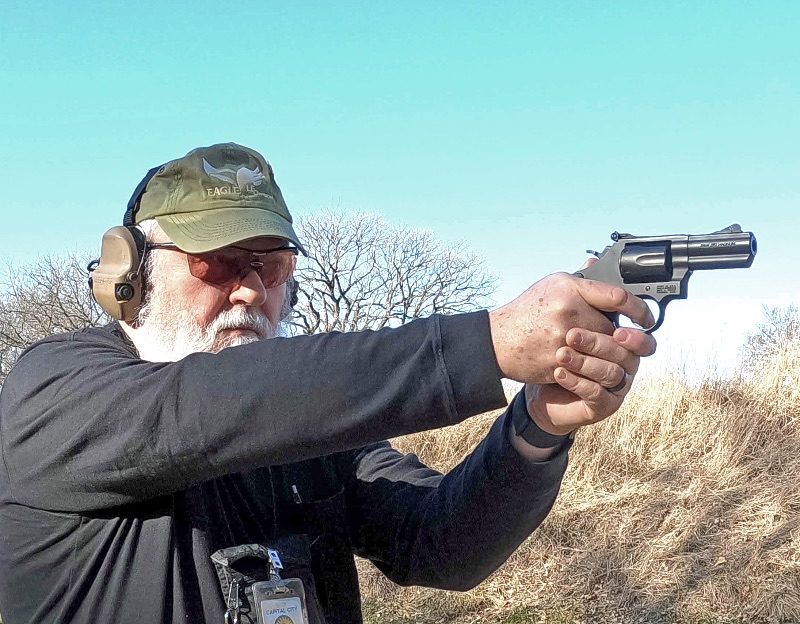
Is he wrong?
Actually, gunpoint is wrong, as we’ve covered here before (one example is here, another here).
“In the self-defense context,” he notes, “on target, on trigger needs to go.”
Actually, the point is “in the self-defense context, gunpoint needs to go.” If there’s muzzle on meat, we’re in the process of shooting (unless something stops that train). Otherwise, the muzzle is averted in the safest available direction, usually a muzzle-averted (thanks, Dave Spaulding) low ready.
Low ready has acres of advantages – not the least of which is complete vision of the (incipient) crime scene pre-engagement. If shooting’s not needed, so much the better.
When this topic was discussed with someone like me, trained in an earlier century, I noted that gunpoint was UNSAT, a no-go at this station.
“If you don’t have it aimed in, the offender will believe you won’t shoot him.”
Add that attitude to the justifiably famous “Stupid Rules” from John Farnam. It could be the last mistake he ever makes, but it’s his choice, not mine.
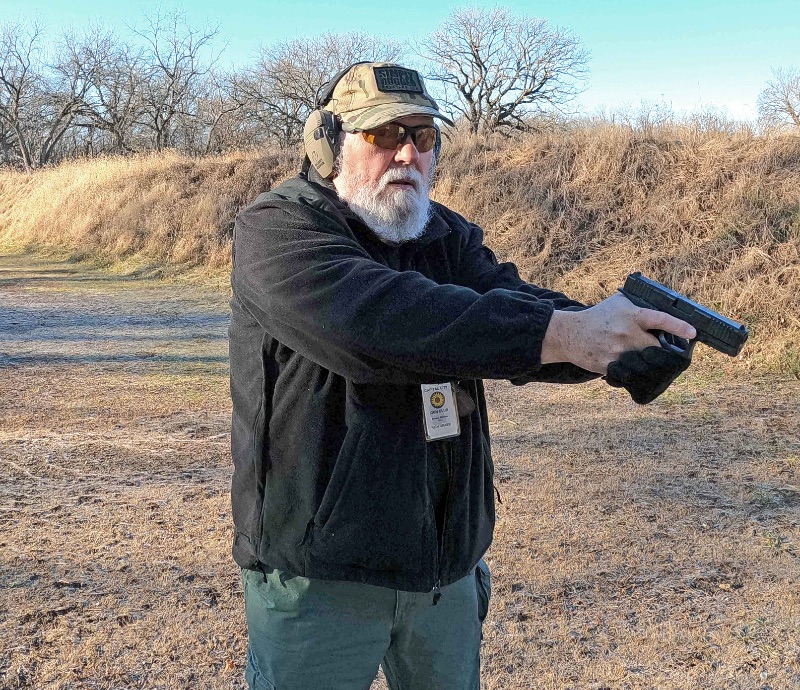
How quickly can you get a hit from guard? Depends on the available target area and distance. It was covered in the linked articles above.
In 2009, Jeff Hall did a piece for The Firearms Instructor, the magazine for the International Association of Law Enforcement Firearms Instructors. In it, he discussed “contact ready,” kind of a compressed high ready with the muzzle leading the user during a search or when confronting a potentially armed suspect.
He mentioned what I always called the “trigger check,” an involuntary flicker of the index finger from register (straight on the frame, hooked on the frame or up in the ejection port) down on to the trigger, as if making sure the trigger is there.
It’s real. I’ve caught myself doing it on a square range and during a force-on-force exercise.
Jeff, a retired Alaska State Trooper and national-class firearms instructor-trainer, noted this: “I encourage trainers to adopt a ready or “guard” position for all challenges (sic) and searches. Depress the muzzle to about 45 degrees, off any part of the suspect. Keep the muzzle off the target until the decision has been made to fire (rule 3); only then, go on target, on trigger, and resolve the problem. It will allow better visibility during searches, allow a full view of suspects’ hands, discourage tunnel vision, and will keep everyone safer. It may take some re-training of officers, but that’s what we do, and we shouldn’t be afraid to tackle this training issue.”
I agree, but I’m not alone.
Marty Hayes (RIP), former cop, instructor and owner of Firearms of Academy of Seattle, and, later, creator of the Armed Citizens’ Legal Defense Network, wrote a piece for our Concealed Carry Special Edition of 2013. He covered common mistakes in self-defense shootings.
“My advice is to avoid drawing the gun unless you absolutely need to do so, avoid pointing the gun at anyone unless you absolutely need to do so, and then call the police to report the criminal activity which caused you to draw the gun. If you cannot articulate criminal activity on the part of the aggressive parties, don’t draw the gun.
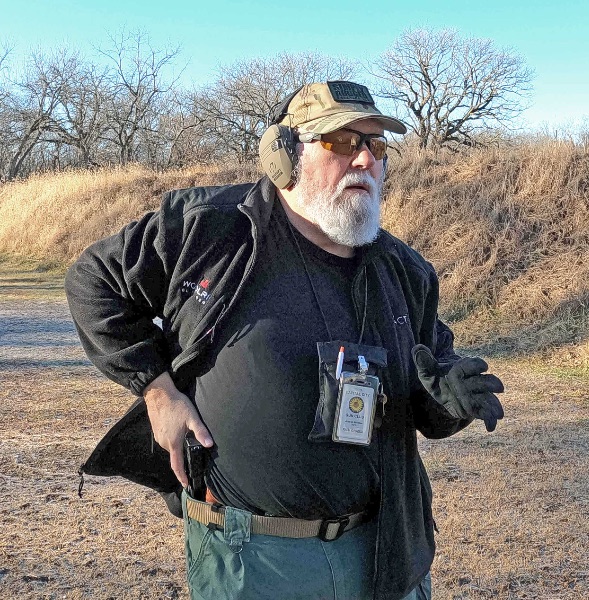
“An alternative to drawing the gun at all is simply to take a bladed stance, with gun side away from the potential attacker or attackers, and place your hand on the gun underneath your concealment garment, with a warning to back off. Your resolve to use deadly force if necessary is communicated, but there is no exposure of the gun.”
That’s a covered low ready – having a firing grip on the holstered handgun without removing it from the holster. This is a technique taught by Mas Ayoob (and others) and was a staple of walking up on a night-time car stop, among other police activities.
It’s demonstrably quicker than starting with the gun hand anywhere else.
We’re victims of our own experiences. I’ve personally had issues with gunpoint as a practice. These are the result of having taken potentially dangerous individuals at gunpoint early in my career.
Aside from the problems inherent in “muzzling a no-shoot target,” there are practical concerns. Gunpoint, even aimed in at the groin, blocks much of your view of the situation. Someone starting with hands in pockets (one on a hidden gun) can get a shot fired on you before you can respond from the “groin gunpoint.” Some of the motion is blocked from your view and slower motion is often not responded to as quickly as fast motion.
The biggest problem is that there may be something you can’t see that got between you and the felon.

At the risk of repeating myself, my last operational use of force was during a high-risk car stop on a residential street in town. Our interdiction people stopped the offenders in a prelude to a search warrant execution, at the approach to a T-intersection with the offender’s car pointed at the cross street (blocked at each end by other units) and a field.
I was behind the stack, moved up on the right to take up a position as forward observer (so I could have eyes on the entire right side of the offenders’ vehicle). A large tree in the yard was to my immediate front and I was at low-ready, peering around the tree.
The interdiction cops were using verbal commands on the occupants of the car when I noticed one of my investigators moving from the back of the car to a position in God’s Great Open © between my muzzle and the object of my scrutiny.
As this is a professional news service, I won’t repeat my instructions that I uttered that day. We did have a discussion about cover after that.
Had I been “at gunpoint,” I likely wouldn’t have seen him kneeling in front of my muzzle.
At guard, I saw him move into his obstructive position.
Without being disrespectful to Mas, for me, it’s not “on target, on trigger.” It’s “OFF TARGET, until you have to shoot.”
— Rich Grassi