
We learn all kinds of lessons, from all kinds of activities – often the lessons learned have little or nothing to do with the particular activity in which it’s learned. A
strange human trait is to seek order and commonality.
I was placed, as a punishment, with a traffic unit “back in the day.” Apparently, the loser who got the joy of my company was likewise sideways with the outfit, so it was “two birds, one stone.”
The individual with whom I was placed had idiosyncrasies. Those included the notes on the back of the traffic ticket, for officer testimony in court.
This was well before personal computers, let alone Mobile Data Terminals and machine-printed summonses.
As part of his notes for moving radar tickets, he had a formula: seconds and combined speeds. I questioned it.
He’d been asked, by an attorney (yes – the defendant paid an attorney to attend a radar ticket case) how far the defendant’s car was from his car when the illegal speed was observed. He couldn’t give “even an estimate” that was credible without data.
He lost. After that, he cracked the books. Remember, this was pre-internet.
Converting miles to feet and hours to seconds allowed him to derive the factor by which he would multiply to get his distance estimate.
When he visually observed an oncoming vehicle traveling at excessive speed, he confirmed it by radar which showed his speed and the target speed. Noting those and counting until the vehicles met gave him an estimate of the seconds it took to meet. Adding his speed to the target speed and multiplying by his conversion factor gave the estimate of radar-to-target distance when the excess speed was observed.
He did the calculations in his head.
Needless to say, he didn’t need it until he did. Same attorney, different big-bucks defendant, but he had the answer. It took time to explain the process in court.
It didn’t require a precise distance to target to convince the judge that the deputy had done the homework. The attorney, bumfuzzled, lost the case.
Hard skills, it’s noted, are those one can quantify. “Soft” skills include tactics – those are subject to many variables including the fact that the opposition has a vote.
An article, posted here, included a statement about testing skills in CQB with Airsoft. Among other conclusions, the author (@HavocTwoOne) concluded “Marksmanship skills are more important than CQB shenanigans. “”Good” tactics vary. Consistent, fast hits do not.”
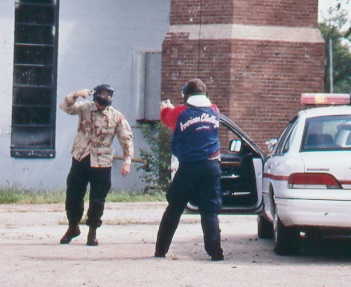
The author of the piece continues – “Marksmanship is very objective and epitomizes hard skills. Good shooting can be readily measured, and improving it is consistently beneficial in every environment and situation.”
There’s a bit to unpack there. As noted in the piece, engaging in battle at whatever level may result in personally negative outcomes – no matter how good you are.
The thing that remains – though not at the level of the peace and calming environment of the shooting range – is one’s ability to make hits on a target.
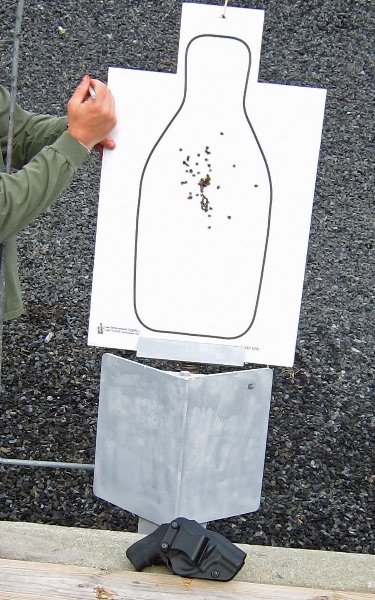
What is your cold, on-demand performance level? Repeating such evaluations over time gives you data. Accumulating it and making a calculation of your on-demand ability to make a hit on a particular size of mark 100% of the time on the range gives you something that won’t go away. In particular, determine your consistency, as discussed here. The fewer extremes in precision, the better.
Making the hit is critical. Not getting hit is even better.
Demanding that every trainee gets force-on-force training runs up against the point: if they can’t shoot, the “training” won’t matter. Get them to a standard – a standard consistently attained -- then add scenario-based training. This standard doesn’t have to be the National Match Course – though there are worse.
Tactics and CQB is best considered in advance. Planning, assuming the worst, and not going in where angels fear to tread goes a long way to success. For those of us outside active service, complete avoidance is the objective.
For those still in service, consider your approach to every situation. Put the disadvantage on the opposition. Use time to your best advantage.
And get those hard skills sorted out.
— Rich Grassi